How do you reduce healthcare costs for employers? Focus on employees with mid-range care costs, whose everyday choices a plan can change. Adjust plan design, help them choose the plan that fits the care they expect, and steer routine care to in-network, lower-cost providers. Raising deductibles shifts costs to employees while prices keep rising.
Employers expect the total health benefit cost per employee to rise 8.2% on average in 2027, according to a survey of more than 1,800 employers by Mercer, now part of Marsh. Many will answer by raising deductibles or the share of the premium workers pay, which moves part of the bill to employees without lowering the price behind it.
The bigger savings come from two everyday decisions made by employees with mid-range care costs: which plan they pick, and where they get routine care. That group drives nearly as much spend as the few members with the largest claims, and unlike much of the care behind those claims, its choices are ones a plan can change.
Key takeaways
- Employer health benefit costs are expected to rise 8.2% on average in 2027, according to Mercer. HR needs to lower spend, not just shift more cost to employees.
- Ask your broker or TPA to split claims into low, middle, and high-cost members. The middle group drives 47.5% of spend through everyday choices, according to Healthee member data from 2026.
- Price plan designs that lower copays at lower-cost providers before you raise deductibles.
- Use decision support tools at enrollment so employees can compare plans against the care they expect, their regular doctors, and estimated yearly costs.
- Use cost estimates to steer routine care to in-network, lower-cost providers. Imaging, labs, maternity care, and surgery are the biggest opportunities.
- If you’re self-insured, review network and vendor contracts. 92% of employers expect to use a center of excellence, high-performance network, or accountable care organization by 2027, according to Business Group on Health’s 2027 survey, as reported by Healthcare Dive.
What are employer healthcare costs?
Employer healthcare costs are what a company pays for its employees’ health coverage: premiums to an insurer for a fully insured plan, or claims plus administration fees for a self-insured plan. A self-insured plan, also called self-funded, is one in which the employer pays medical claims itself instead of paying an insurer to carry the risk. 71% of covered workers are in self-funded plans, according to KFF’s 2026 Employer Health Benefits Survey.
The cost comes from the price of each service, how much care employees use, and who pays which share through cost sharing, meaning deductibles, copays, and coinsurance (the percentage of a bill employees pay).
| Lever |
What it changes |
What HR does this quarter |
What to ask your broker or TPA |
| Plan design |
Who pays, and which choices cost employees less |
Price a renewal option that lowers copays at lower-cost providers before pricing a higher deductible |
“What does each design change do to plan cost and to employees’ out-of-pocket costs?” |
| Steering care to in-network, lower-cost providers |
Price |
Show employees their estimated cost when they search for care |
“Which routine services cost us the most, and at which providers and settings?” |
| Utilization |
Use |
Find which services drove last year’s growth before choosing a fix |
“Which services and drug classes grew fastest in our claims last year?” |
| Claims data review |
None directly. It shows which of the three to change first |
Ask for claims spend split by each member’s annual cost |
“Can you split our claims spend into low, middle, and high-cost members before renewal?” |
Why employer healthcare costs keep rising in 2027
Employer healthcare costs keep rising because the prices of care keep rising, and more employees are using expensive treatments such as GLP-1s. Cutting benefits lowers what the plan pays, but it doesn’t lower the price of care.
Hospital prices are one of the main reasons. Private insurance prices for hospital care rose 30% from April 2019 to April 2026, compared with 21% for Medicare rates, according to KFF. Employers pay those prices through premiums or claims. In 2026, annual premiums for family coverage reached $28,303, up 5% from 2025, and workers paid $7,471 of that on average, according to KFF.
The increases continue into 2027. Employers told Mercer their current plans would cost 11% more if they made no changes. After their planned changes, they expect costs to rise 8.2%. GLP-1 use alone adds a full percentage point to 2027 cost growth (see our guide to GLP-1 employer coverage options).
Faced with these rising prices, 59% of employers are thinking about “plan design changes like higher deductibles that can increase members’ out-of-pocket costs,” according to Mercer. A higher deductible lowers what the plan pays, but it doesn’t change the price of care. Prices keep rising, so employees pay more for the same care and HR faces another increase at the next renewal. Bringing spend down means changing the care decisions behind it, and employees with mid-range care costs make many of those decisions.
Where employer healthcare spend comes from
Healthee’s member data sorts members into three groups by what their care costs in a year. The groups differ in how much of their spend a plan can change.
1. A small share of members drives about half of spend
Members whose care costs $30K or more a year make up 5% of people and drive about half of spend, according to Healthee’s member data. Much of that is necessary care for cancer, chronic conditions, and premature births. In Business Group on Health’s 2027 survey, as reported by Healthcare Dive, 70% of employers named cancer their No. 1 cost driver for 2026, the fifth year in a row it topped the list.
Better benefits guidance helps these employees find good care, but it can’t make cancer treatment cheap. Self-insured employers can still change the networks and vendor contracts that care runs through.
2. Members with mid-range costs drive 47.5% of spend through everyday choices
These members, whose care costs $1.4K to $30K a year, represent about 45% of people, according to Healthee member data from 2026. Their costs come from care like an MRI, a specialist visit, a prescription, or a planned procedure.
These costs are easy to overlook because they’re spread across many smaller claims rather than one large claim. They still add up. That makes the mid-range group the best place to start lowering costs without cutting benefits.
Employees in this group make two decisions that affect cost. At open enrollment, they pick a plan to cover the care they expect to need. During the year, they choose where to get each service, such as which imaging center or which specialist. A plan’s design and the tools employees have can shape both decisions.
3. The same care costs more depending on where employees get it
The Health Care Cost Institute compared what 57 services cost people with employer-sponsored insurance in hospital outpatient departments and in physician offices in 2022. It found that “prices at hospital outpatient departments are consistently higher than physician offices.” That year, Level 1 imaging without contrast, such as an X-ray, averaged $227 at a hospital outpatient department and $61 at a physician’s office.
Employees sent to a hospital for imaging like this may not know whether a physician’s office nearby charges less, because the difference often isn’t in front of them when they search. HR can close that gap by showing employees each provider’s price before they book.
How can HR benefits leaders lower corporate healthcare claims and renewal costs?
HR and benefits leaders lower claims and renewal costs by finding which members drive spend, changing plan design before raising deductibles, and showing employees with mid-range care costs what they’d pay before they choose a plan or provider.
1. Split your spend into low, middle, and high-cost members
A claims report sorted by service, provider, or large claim shows where the money went, but not which members’ decisions drove it. Before renewal, ask your broker or TPA to split last year’s claims spend into three groups by each member’s annual cost:
- Under $1.4K
- $1.4K to $30K
- $30K or more
If your split looks like Healthee’s member data, the middle group carries nearly as much spend as the high-cost group, spread across far more people.
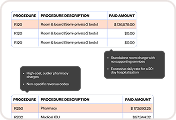
Then ask which services make up most of the middle group’s spend, and what share goes to out-of-network providers, meaning providers who haven’t agreed to your plan’s negotiated prices. If that share is large, start with where employees get care.
2. Change plan design before you shift more cost to employees
Many employers meet a rising renewal by moving cost to employees. Among large firms, the most common employer action in 2026 was “increasing the share of the premium that workers contribute toward their coverage,” at 44%, according to KFF. KFF also reports that 38% of covered workers are in a plan with a general annual deductible of $2,000 or more for single coverage. A larger worker share and a higher deductible both lower what the plan pays by raising what employees pay.
Other design changes lower spend instead of moving it. Over a third of large employers plan to offer some type of non-traditional medical plan in 2027, such as a variable copay or high-performance network plan, according to Mercer. A variable copay plan charges a lower copay at lower-cost providers, so employees pay less when they choose one, and so does the plan. A high-performance network plan covers a narrower set of providers chosen for cost and quality.
Before your broker prices a higher deductible, ask for an option that keeps the deductible and lowers copays at lower-cost providers for the services your middle group uses most. Compare the two on plan cost and on what employees would pay. If you’re weighing a high-deductible health plan (HDHP), start with our guide to how much to fund an HSA before offering an HDHP.
3. Help employees choose the plan that fits the care they expect
A plan that looks cheap at enrollment can cost employees more by year end if they need care, and many employees can already predict that care. In Healthee’s 2026 Benefits Divide report, 54.56% of enrollees said they expected medium to high medical needs in the coming year.
Networks matter too. Provider networks were the most important factor in choosing a health plan, ahead of premiums and other plan features, according to EBRI’s 2025 Consumer Engagement in Health Care Survey of privately insured adults. An enrollment guide lists premiums and deductibles, but it can’t show what each plan would cost a family for the care they expect, or whether their doctors are in network.
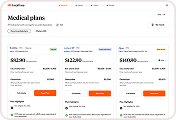
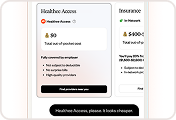
This is where plan choice becomes part of lowering healthcare costs. A decision support tool, like Healthee’s Decision Support Tool, shows employees both at enrollment. After a short intake about who’s covered, what care they expect and who their regular doctors are, employees see their top three suggested plans. The tool ranks each plan on the care they expect plus a prediction of care they didn’t plan for, and it weights cost more heavily than network. For each plan, employees see:
- An estimated yearly cost, including the premium and any employer HSA contribution
- A best case: premium only
- A worst case: premium plus the out-of-pocket maximum, the most they’d pay in a year
- Whether their doctors are in network
For employees choosing between an HDHP and a PPO, the yearly estimate shows which plan costs less for the care they expect. Our HDHP vs. PPO comparison explains the trade-offs.
Add a link to the tool next to the plan summary in your open enrollment checklist for HR, so employees compare plans using their own numbers instead of only the guide’s premium and deductible list.
4. Steer employees away from expensive out-of-network healthcare providers
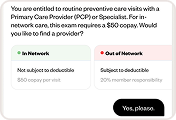
Out-of-network providers haven’t agreed to your plan’s negotiated prices, so employees who use them can pay more for the same routine care. Finding a covered option isn’t always easy. In EBRI’s 2025 survey, 13% of insured adults who delayed or avoided care said they had trouble finding an in-network doctor or facility. Prices also vary by setting, as the hospital X-ray from earlier showed.
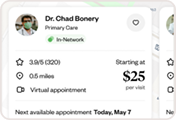
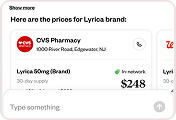
A navigation platform, like the Healthee app, shows employees their cost before they choose a provider. When employees search Find Care for a procedure, they see in-network providers, each with an estimate of what they’d pay out of pocket there.
How can self-insured employers reduce healthcare claims costs?
Self-insured employers reduce claims costs by changing the networks and vendor contracts their claims run through. Those changes reach the members with the largest claims, whose care is often necessary and won’t get cheaper through guidance alone.
Among employers in Business Group on Health’s 2027 survey, as reported by Healthcare Dive, 92% expect to use at least one center of excellence, high-performance network, or accountable care organization by 2027. A center of excellence is a provider chosen for strong results in one complex area, like cancer care. An accountable care organization is a group of providers paid partly on the cost and outcomes of the patients they share.
The same businesses are looking at vendor contracts as they consider ways to lower costs. One-third expect a “transparent” or “new generation” PBM, the pharmacy benefit manager that runs a plan’s prescription benefit, in place by 2027. And 83% are expanding performance guarantees, contract terms that put part of a vendor’s fees at risk if it misses agreed results, while 71% are tying vendor reimbursement to outcomes.
At your next vendor renewal, ask your broker or consultant which vendors offer performance guarantees tied to cost or outcomes, and whether a center of excellence for your largest claim category, such as cancer, fits your network.
Make benefits easier for you and your employees
Two numbers show whether these steps are working. The first is how much of the spend by members with mid-range care costs goes to in-network, lower-cost providers, which your broker or TPA can add to the split you asked for. The second is how many employees saved the plan that a decision support tool suggested at open enrollment.
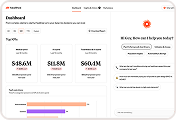
Bring the first number to finance, because it tracks a larger share of care bought at lower prices, with no more of the bill moved onto employees’ paychecks. The second shows whether employees used the tool when they chose a plan. Healthee’s Decision Support Tool and cost estimates in Find Care show employees what they’d pay before they choose, and HR sees in Healthee Pulse how many saved a suggested plan.