Employers expect the total health benefit cost per employee to rise 8.2% on average in 2027, the highest increase since 2003, according to preliminary results from Marsh’s 2026 National Survey of Employer-Sponsored Health Plans. If they leave their plans as they are, employers expect costs to rise 11%.
Simon Camaj, Marsh’s US Health and Benefits Leader, put it plainly: “Few organizations can absorb health cost increases that outpace inflation” without making difficult financial decisions.
For HR leaders, that can mean a harder budget conversation this year. Just the usual ROI projection probably won’t convince the CFO to approve your benefits budget this time. Without a case finance can check, cuts often become the default: 59% of employers plan cost-cutting changes for 2027, including higher deductibles, according to Marsh.
You should start from numbers finance can verify: what today’s plan will cost next year and the year after if nothing changes, where in the plan spend can actually move, and measured usage, rather than projected savings, to show the program is working. Here’s how to build each part.
How to present a benefits budget to the CFO
Each of these steps can give your CFO something they can check, so by the time you make your ask, they’ve already seen the numbers behind it.
1. Show what your plan will cost if nothing changes
Start your budget case with what the plan will cost if you leave it alone. Without that number, finance will read your request as new spending on top of a cost that’s already rising.
You need 3 numbers to derive that number:
- Today’s spend. This is what you pay for the plan now. For scale, the average annual premium for employer-sponsored family coverage at firms with 10 or more workers reached $26,993 in 2025, 6% higher than in 2024, according to KFF’s 2025 Employer Health Benefits Survey.
- Next year’s renewal increase. Ask your broker or consultant what the renewal will be if you keep the plan exactly as it is. Your number may be higher or lower than the 11% average employers reported to Marsh, which is why finance will want yours.
- The trend for the year after. Ask your broker or consultant what increase they expect the following year.
Apply the renewal increase to today’s spend to get next year’s cost. Then apply the following year’s trend to that new total to get the year after. For example:
|
Today |
Next year (+11%) |
Year after (+8%) |
| Plan cost |
$5,000,000 |
$5,550,000 |
$5,994,000 |
Example figures for illustration only.
Show your CFO the 3 years side by side. They’ll see what the company will pay if nothing changes, and they can weigh the rest of your case against that number.
This week: Email your broker or consultant and ask for 2 numbers – the renewal increase if you keep the plan as it is, and the trend they expect for the year after.
2. Show where in the plan spend can move
If your CFO sees only one total, cutting benefits will look like the only way to lower it. Break that total down by how much each member spends, so finance can see which parts of the plan you can influence.
Across Healthee’s member data in 2026, spend splits like this:
| Group |
Annual spend per member |
Share of members |
Share of spend |
| High-cost |
$30K+ |
5% |
49.7% |
| Everyday care |
$1.4K to $30K |
45% |
47.5% |
| Low-use |
Under $1.4K |
50% |
About 3% |
Two groups drive almost all of the spend:
- High-cost members are 5% of members and 49.7% of spend. Most of this is necessary care for cancer, chronic conditions, and premature births, so your benefits program shouldn’t try to steer it.
- Everyday care members are 45% of members and 47.5% of spend. This covers MRIs, specialist visits, prescriptions, and procedures. Employees choose where to get this care, so this is the spend you can move.
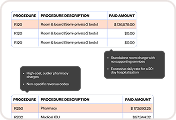
The same service can cost very different amounts depending on where an employee goes, and most employees don’t compare prices. In a National Bureau of Economic Research study of MRIs, patients went to a provider that had, on average, 6 cheaper options closer to home, with little difference in quality. Choosing the cheapest option would have cut MRI spending by about 36%. Fewer than 1% of patients checked a price tool first.
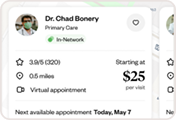
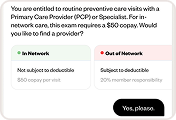
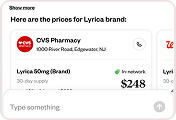
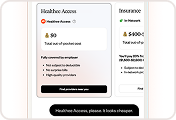
That’s why cost estimates need to reach employees while they’re deciding where to go. Say an employee’s doctor orders an MRI. They can ask Zoe, Healthee’s AI health assistant, where to go. Zoe checks how much of their deductible they’ve already met, lists in-network providers with quality scores, and shows an estimated out-of-pocket cost for each one before they book. When employees choose care this way, it shows up in claims: one e-commerce retention company that uses Healthee saw 7% lower claims costs.
This week: Ask your broker or consultant for last year’s claims spend broken into the same 3 groups – high-cost, everyday care, and low-use – with the share of members in each.
3. Agree with finance on how you’ll show results
Once your CFO has seen the baseline and the spend split, they’ll likely ask how to confirm the money is working. A projection can’t answer that until the year is over. Measured usage can answer it during the year.
Then agree with finance on 3 things for each checkpoint:
- Which measures it will show
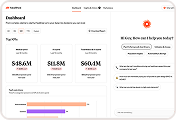
For metrics, start with usage: how many eligible employees register, activate, and use the app each month. These numbers show finance early on whether employees are using the help it paid for. One marketing platform that uses Healthee reached 76% benefits utilization. You can report usage alongside the KPIs in our list of 10 health plan performance metrics CFOs track.
If you use Healthee, the engagement dashboard in Healthee Pulse, the employer platform, tracks that path from eligible employees to registered, activated, and monthly active. It compares the last 1, 3, 6, or 12 months with the period before. Choose the sections finance cares about, download them as a PDF, DOC, XLS, or CSV, and bring the same report to every check-in.
This week: Book your first checkpoint with finance, and agree on the period it will cover and the metrics it will report.
Make your benefits case with numbers your CFO can check
Your CFO is more likely to approve a benefits budget built on numbers they can check. Start with what today’s plan will cost next year and the year after if nothing changes. Then show where that money goes, and which part of it your program can move. Finally, bring measured usage to the checkpoints you agreed on, so finance can see the program working.
Healthee helps you make that case. Zoe, Healthee’s AI health assistant, shows employees estimated out-of-pocket costs before they book care. Healthee Pulse gives you the usage reports to bring to every checkpoint.