I agree to receive transactional SMS messages from Healthee. Msg frequency varies. Msg & data rates may apply. Text STOP to unsubscribe and HELP for help. Privacy PolicyTerms of Use
Employees are expected to compare premiums, deductibles, provider networks, prescriptions, HSAs, FSAs, and other plan details, often while trying to predict healthcare needs they cannot possibly know with certainty. Then HR sends them a 1,500-word email and hopes for the best.
There is a better way to reach out to your workforce and get engagement.
A strong open enrollment communication strategy should help employees answer three questions:
What is changing?
What does it mean for me?
What should I do next?
Getting those answers right matters. According to KFF’s 2025 Employer Health Benefits Survey, the average annual premium for employer-sponsored family coverage reached $26,993, with workers contributing $6,850 on average.¹ Benefits decisions carry real financial weight for employees and their families. That is why the goal of open enrollment communication should not be to distribute as much information as possible. It should be to make the next decision easier.
Why more communication is not always better
Here is the problem with the traditional open enrollment campaign: Too much information often arrives at exactly the wrong time.
HR tries to fit plan changes, deadlines, rates, links, disclaimers, educational materials, and reminders into one launch email. The result is overwhelmed employees who see a wall of information, decide they will come back later, and unintentionally wait until the last minute to finalize their decisions.
Sound familiar?
The answer is not necessarily another reminder. The better approach is progressive communication. Introduce the decision first, explain what changed next, then help employees compare their choices. Finally, as the deadline approaches, remove information rather than adding it.
That last point may sound backward, but it is one of the most important principles in this playbook.
The closer you get to the enrollment deadline, the less you should say. Employees who have waited until the final 48 hours probably do not need another lesson on coinsurance. They need to know when enrollment closes, what action they need to take, where to take it, and where to go if they get stuck.
That approach aligns with the CDC Clear Communication Index, which emphasizes a clear primary audience, one main message, familiar language, and an obvious call to action.² CMS takes a similar approach with its standardized Summary of Benefits and Coverage, designed to make health plan information easier to understand and compare.³
Clarity beats volume.
The key points for building a communication strategy
Before anyone starts drafting subject lines, build a one-page campaign brief. Your team should be able to answer five questions:
What does the employee need to do, and by when?
Is enrollment active or passive?
What is actually changing this year?
Which employee populations need different guidance, translations, or accessible formats?
Where should employees go when they have a question specific to their healthcare or household?
No campaign can account for every prescription, doctor, dependent, planned procedure, or financial priority. HR should not try to cram answers to every possible question into campaign copy.
Instead, give employees a clear path to the answer.
Required notices and delivery methods should also be confirmed with your benefits counsel or compliance partner. Open enrollment communication can make required information easier to find and understand, but campaign messaging should support official plan documents rather than attempt to replace them.
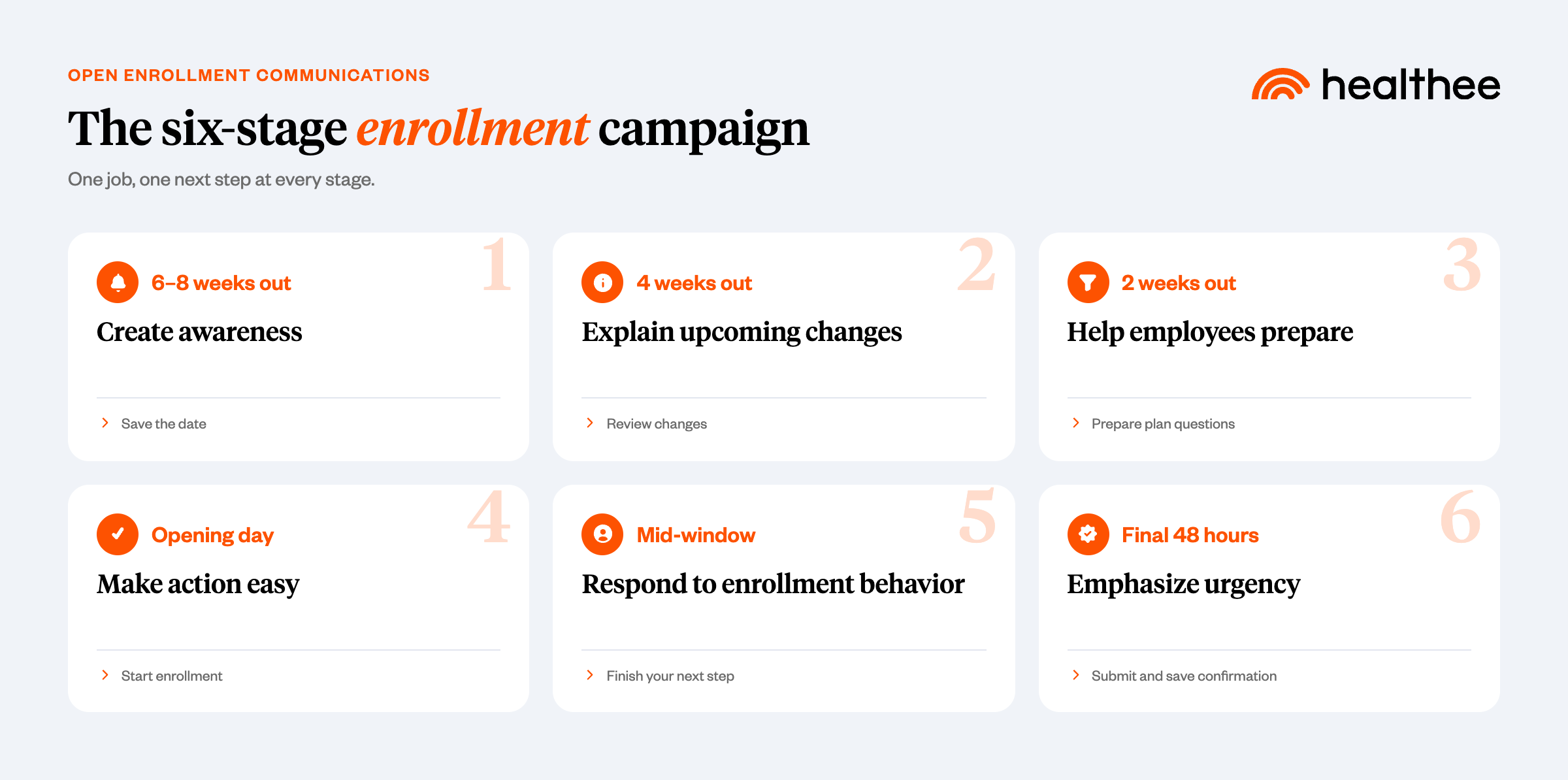
The six-stage open enrollment communication calendar
Instead of announcements, think of open enrollment communication like a marketing campaign, each message should have a primary goal and a call to action, or next step, for employees to follow.
1. Six to eight weeks before: Create awareness
Start simple with a concise save-the-date from a recognizable leader. Include the enrollment window, whether action is required, and where updates will live.
This message is not the place for plan grids or detailed rates. Do not attach the entire benefits guide or include a massive comparison chart just yet. At this stage, the focus is creating awareness instead of expecting a final healthcare decision.
Recommended call to action: Add the enrollment window to your calendar.
2. Four weeks before: Explain upcoming changes
Now answer the question employees actually care about: What’s different this year?
Organize changes according to their impact on employees. Explain what is new, what is staying the same, and which employees should pay particularly close attention.
If employee contributions are changing, make the financial impact easy to understand. Showing a per-paycheck amount alongside an annual figure, for example, can make a change much easier to put into context.
Additionally, now is the time to link employees back to your central source of truth for complete plan materials.
Recommended call to action: Review plan changes
3. Two weeks before: Help employees compare
This is where education becomes your best tool. Instead of explaining each feature in isolation, teach employees about common factors to consider when selecting a plan.
Questions might include:
Which doctors do you want to keep seeing?
Do you regularly take prescription medications?
What healthcare needs do you anticipate this year?
How much are you comfortable paying in premiums?
How much out-of-pocket financial risk are you comfortable taking on?
How could an HSA, FSA, or HRA affect your decision?
The goal is not to tell every employee which plan is “best.” There is no universally best health plan. Give people a way to understand which option fits their own needs.
Note: This is also a good time for a live session, recorded walkthrough, or benefits Q&A. Publish common questions afterward so the answer to one employee’s question can help hundreds more.
Recommended call to action: Compare your options.
4. Opening day: make action easy
Send the official launch message early in the workday. Inside the message, be sure to put the enrollment deadline, link, and required action where employees cannot miss them. Your employee should know exactly where to click within seconds of opening the message.
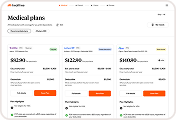
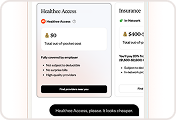
If your team is partnered with Healthee, make sure to pull your employees to the Decision Support Tool for easy plan comparison and
Recommended call to action: Start or confirm your election.
5. Mid-window: respond to behavior
By the middle of enrollment, your employees are no longer one audience as they range in enrollment status from ‘not started’ to ‘completed’. At this stage, multiple segment groups are needed for more customized communication across your workforce.
Employees who have completed enrollment may need confirmation and instructions for reviewing their elections. Someone who started but did not finish needs a quick way back in. Someone who has not started needs the deadline, an idea of how much time enrollment may take, and a clear support option.
Use the questions coming into HR and benefits teams as campaign data, too. If the same question keeps appearing, that is a communication signal to update any FAQs or clarify upcoming messages.
Recommended call to action: Finish the next incomplete step.
6. Final 48 hours and close: increase urgency, then confirm
Use short reminders through two or three approved channels. State the exact deadline with the time zone, explain what happens if no action is taken, and keep the support route visible. After the window closes, send confirmation, explain when coverage begins, and tell employees where to find year-round help.
Recommended call to action: Submit, verify, and save your confirmation.
What changes in the final 48 hours
Urgency can rise, but complexity should fall. Final messages should contain only the deadline, enrollment link, and a support option. Introducing new educational content at this stage gives employees another reason to delay.
The purpose of each communication channel
A multichannel campaign works best when each communication channel plays a distinct role in guiding the audience. Simply repeating the same message everywhere can feel redundant and create noise. Instead, tailor the content to each channel while keeping the overall story consistent. The following guidelines are a great place to start:
Email: Explain context, summarize plan changes, and direct employees to resources.
SMS or push notifications: Deliver short deadline reminders and direct return paths, subject to employee consent and company policies.
Enrollment hub or intranet: Act as the durable source of truth for documents, FAQs, recordings, deadlines, and support information.
Live and recorded sessions: Explain complicated topics, demonstrate tools, and answer common questions.
Manager toolkit: Give managers approved talking points, dates, and escalation routes without expecting them to interpret individual coverage.
Benefits navigation platform: Give employees somewhere to take the personal questions that campaign copy cannot answer.
Accessibility should be part of this strategy from day one. Use meaningful link text, captions and transcripts, readable formatting, mobile-friendly pages, translated materials where appropriate, and alternative ways to access required information.
Open and click rates are useful delivery signals, but they do not show whether employees made a confident decision. During your communication window, track signals such as:
Enrollment completion by day and workforce segment
Employees who start but do not complete enrollment
Attendance and replay views for educational sessions
Common search terms and employee questions
Benefits-related HR inquiry volume
Support response times
Post-enrollment employee confidence or clarity
If one question suddenly dominates employee conversations, do not wait until next year’s retrospective to address it. Update the FAQ, adjust the next communication, and make sure everyone answering benefits questions is working from the same information.
How benefits navigation supports open enrollment
Even a well-planned campaign cannot anticipate every family situation, provider preference, prescription, or financial priority. That is where benefits navigation becomes useful. Healthee centralizes benefits information and gives employees access to Zoe, an AI benefits assistant that can answer plan-specific questions in real time.
For HR, that creates a cleaner division of labor. Campaign communications establish the timeline, explain company-level changes, and direct action. Personalized navigation handles the individual questions that would otherwise arrive as one-off emails and tickets.
The result is not simply more communication. It is a more useful benefits experience: one campaign path for the workforce, plus on-demand guidance for the person making the decision.
Key Takeaways: The strategy matters as much as the messaging
The best open enrollment communication strategy is a coordinated system. It has a defined audience, one source of truth, a staged calendar, channel roles, accessible materials, and a clear support path. Once those pieces are in place, drafting becomes faster and reminders become more relevant.
Start with the six-stage calendar, assign an owner to each send, and review last year’s questions before you write. Employees do not need every detail at once. They need a clear next step, followed by a trusted place to get the answer that fits their lives.
Begin awareness six to eight weeks before the enrollment window. Introduce key changes about four weeks before, teach plan comparison two weeks before, and increase action-focused reminders after the window opens.
How many open enrollment messages should HR send?
There is no universal number. A six-stage sequence is a practical baseline, with segmented mid-window and final reminders. The goal is to give each message one job rather than repeat the same full announcement.
What should every open enrollment message include?
Include a clear main message, the action required, the deadline when relevant, a direct link, and a trusted support option. Required plan notices and official documents should remain easy to access.
How can HR reduce open enrollment questions?
Use plain language, publish a central FAQ, segment reminders based on completion status, and offer on-demand benefits navigation for personal or plan-specific questions.