I agree to receive transactional SMS messages from Healthee. Msg frequency varies. Msg & data rates may apply. Text STOP to unsubscribe and HELP for help. Privacy PolicyTerms of Use
Voluntary benefits explained: How to increase employee enrollment
March 31, 2026
Voluntary benefits have quietly moved from the sidelines to the center of benefits conversations. What used to be a small set of optional add-ons has expanded into a broad category of offerings that employees actively expect and evaluate.
Employers are responding by adding more options, but many are discovering that expansion alone doesn’t drive engagement. The reality is that voluntary benefits introduce a new kind of complexity. When employees are already struggling to understand core health plans, adding more choices without guidance can actually reduce participation.
To get voluntary benefits right, organizations need to rethink not just what they offer, but how employees experience those offerings. In this post, we’ll explore what voluntary benefits are, why they matter, and how to roll them out without confusion or complexity.
What are voluntary benefits?
Voluntary benefits are optional, employee-paid insurance products offered by employers that sit alongside traditional core benefits like medical, dental, and vision.
They’re typically flexible and designed to address specific risks or lifestyle needs beyond standard coverage. While employers facilitate access, employees usually bear most of the cost through payroll deductions.
Common examples include:
Pet insurance
Identity theft protection
Legal services
Accident insurance
Hospital indemnity plans
Long-term and short-term disability
Commuter benefits
In recent years, the category has expanded to include more lifestyle-oriented offerings, which reflects a broader view of employee well-being. This shift signals a move away from one-size-fits-all benefits toward more individualized support.
For employers, voluntary benefits create an opportunity to enhance the overall value of their benefits package without significantly increasing direct costs. However, that opportunity only pays off if employees understand what they’re selecting and why it matters. Without that clarity, voluntary benefits remain underutilized and undervalued.
The voluntary benefits bind: High-value offerings, low employee adoption
Voluntary benefits often suffer from a perception problem. Employees see them as optional or unnecessary because a specific situation hasn’t happened to them yet. Their pet is healthy, identity theft feels unlikely, and a potential hospital stay isn’t top of mind during open enrollment.
That perception changes quickly when an unexpected event occurs.
Medical bankruptcies, for example, remain a leading cause of personal financial crisis. Recent Aflac research shows that 50% of all workers can’t cover more than $1,000 in out-of-pocket costs for an unexpected illness or injury.¹ With average per-day hospital costs hovering around $3,100, unplanned critical illness would lead to a devastating financial situation for many Americans.²
By the time an employee realizes the true value of voluntary benefits, the enrollment window has already passed. This gap between anticipation and reality is a huge barrier to adoption.
Addressing benefits literacy is key
The broader issue stems from a lack of benefits literacy rather than the quality of your insurance products. Health insurance can be confusing, and employees are often left uncertain about how or when to use their benefits. If they don’t have the education they need leading up to open enrollment, they’re going to choose the same plans they’re most familiar with.
Employers who succeed in this space focus on making it easy for employees to understand what voluntary benefits are and how they apply to their personal needs. It’s important to communicate that voluntary benefits aren’t just an add-on; they’re financial protection, convenience, and peace of mind in a specific moment that matters.
The hidden cost of low voluntary benefits selection for HR leaders
Some might consider low participation in voluntary benefits a neutral outcome. Employees are just choosing not to enroll, right? But it actually creates a ripple effect across cost efficiency, employee experience, and HR workload. When benefits are underutilized, organizations are actively losing value from investments they’ve already made.
Here are some hidden costs of low voluntary benefits enrollment:
Wasted investment in negotiated benefit packages
HR teams spend significant time sourcing, vetting, and negotiating voluntary benefit offerings to secure favorable rates and coverage options. When employees don’t enroll, that effort and negotiating power fail to translate into real impact, leaving valuable benefits unused and ROI unrealized.
Decreased employee satisfaction and engagement scores
Employees increasingly evaluate their employer based on the quality and usability of their benefits. When voluntary benefits are poorly understood (and thus, not selected), employees might perceive the overall package as lacking—even if strong options are technically available.
Gaps in financial protection leading to productivity loss
Voluntary benefits are designed to protect employees from unexpected financial stress, whether from medical events, legal issues, or personal risks. Without enrollment in these programs, employees are more vulnerable to out-of-pocket costs, which can lead to distraction, stress, and decreased productivity at work.
Increased time spent answering benefit questions year-round
When employees don’t fully understand the benefits available to them, they’re going to need even more support after open enrollment. HR teams continue to field questions throughout the year, from coverage clarifications to missed enrollment opportunities, adding to an already heavy administrative burden.
Difficulty attracting talent without competitive benefit utilization
Offering a wide range of benefits is no longer enough to stay competitive in hiring. Candidates are looking for proof that benefits are actually usable and valuable. Low utilization can signal the opposite, which makes it harder to differentiate your organization in a crowded talent market.
3 tips for employers to improve voluntary benefits enrollment
Employers that succeed with voluntary benefits take a more intentional approach. They recognize that low enrollment is rarely about lack of interest; it’s about friction in the decision-making process.
By reducing complexity, improving relevance, and scaling support, organizations can turn voluntary benefits into a high-impact part of their strategy. Here are three tips to keep in mind:
1. Curation matters more than volume
Offering more benefits doesn’t necessarily increase engagement. During open enrollment, employees are already facing dozens of decisions within a limited window, often relying on dense materials like 50-page PDFs or sparsely attended information sessions. When too many voluntary options are layered on top, employees default to last year’s elections or skip decisions entirely.
Instead, focus on a curated set of high-impact benefits that align with your workforce’s needs. Analyze employee demographics, claims trends, and utilization data to prioritize the most relevant plans. The goal is not to offer everything, but to offer the right things, in a way that feels manageable and clear.
2. Context is critical
Employees don’t engage with benefits they can’t connect to their own lives. A generic list of features or coverage details won’t help someone understand whether a benefit is worth choosing. This challenge is amplified by the fact that most organizations present the same information to every employee, regardless of age, role, or life stage.
To improve enrollment, employers need to invest in targeted education and personalization. A 25-year-old employee and a 55-year-old employee have fundamentally different priorities, and their benefits guidance should reflect that. Use real-life scenarios, personalized recommendations, and clear examples to show why certain benefits are valuable to them. When employees can see how a benefit applies to their specific situation, they’re far more likely to enroll.
3. Navigation is the foundation
Even with the right benefits and strong communication, decision complexity remains a major barrier. Voluntary benefits require employees to compare costs, coverage levels, exclusions, and how each option works alongside their core plans. This isn’t something employees can effectively do by skimming descriptions.
At the same time, HR teams can’t realistically provide one-on-one guidance at scale. That means teams often rely on mass, generic communications that meet compliance requirements but fail to drive meaningful engagement. The solution is to introduce tools that can deliver personalized, on-demand support to every employee.
Investing in navigation, particularly AI-driven decision support, allows employees to ask questions, compare options, and receive tailored guidance in real time. This not only improves enrollment outcomes but also reduces the year-round burden on HR teams.
How Healthee drove 71.2% in voluntary benefits save rates
The typical decision-making process around voluntary benefits isn’t easy. Employees are expected to evaluate multiple plans, understand how they complement their existing coverage, and make financially meaningful choices in a short window. Without the right support, they default to inaction.
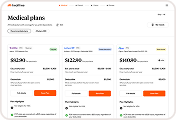
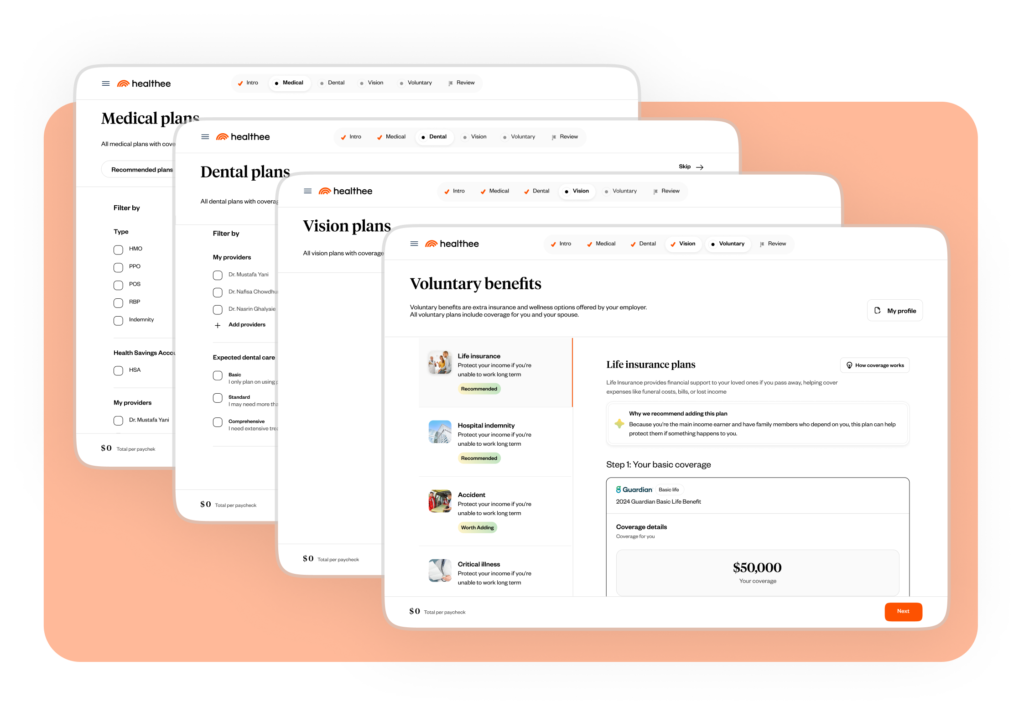
Healthee’s Plan Comparison Tool (PCT) was built to solve that problem. Instead of presenting a long list of options, the PCT interprets and prioritizes benefits for each employee. It uses AI to analyze individual circumstances, including demographics, dependents, and existing elections, then translates that data into clear, personalized recommendations. Employees aren’t just shown what’s available; they get a breakdown of what makes sense for them and why.
Last year, 71.2% of eligible users selected one or more voluntary benefits through Healthee, compared to a 49% industry benchmark. By combining AI decision support with behavioral nudges and clear education, the PCT removes the friction that typically prevents employees from enrolling.
What makes the difference is how the experience is structured:
Personalized recommendations ensure employees see the most relevant voluntary benefits first, rather than sorting through generic options
Clear cost and coverage explanations eliminate confusion and help employees understand the real value of each plan
Integrated comparisons show how voluntary benefits complement core coverage, enabling smarter, more complete protection decisions
Scenario-based guidance replaces insurance jargon with practical, real-life context that employees can easily relate to
Instead of acting as the primary source of support, HR teams can rely on the platform to deliver consistent, tailored guidance to every single employee. With resources like the PCT, voluntary benefits stop feeling like optional add-ons and become essential components of a well-designed benefits strategy.
Check out our recent report to see the impact Healthee is driving through visibility into voluntary benefits and how we use the latest behavioral science and AI technology to drive growth in voluntary benefits.
Increase your company’s voluntary benefits enrollment
Voluntary benefits are growing because employees want more control, personalization, and support for the realities of their lives. Employers are responding by expanding their offerings, but expansion alone doesn’t create value. The overall benefits experience is what determines their success.
Employees need guidance to make confident decisions, and HR teams need scalable ways to deliver that guidance. Without it, voluntary benefits remain underutilized and fail to deliver on their promise.
Healthee helps close that gap by turning complex benefits into clear, personalized decisions. We help employees navigate their options with confidence while reducing the burden on HR. Interested in learning how we can support your company? Reach out to our team today.
Why are employees not enrolling in voluntary benefits, even when strong options are available?
Employees often avoid enrolling because they don’t fully understand how the benefits apply to their lives. When faced with complex choices and limited guidance, they default to familiar options or skip voluntary benefits entirely.
What is the biggest mistake employers make with voluntary benefits?
Employers focus on adding more options instead of improving how employees choose them. Without clarity and support, more choices often lead to lower engagement and utilization.
How can employers improve voluntary benefits enrollment without increasing HR workload?
Employers need scalable, personalized solutions that don’t rely on HR answering every benefits question. AI-driven tools can guide employees in real time, reducing confusion and freeing HR from repeating explanations.
How does Healthee help increase voluntary benefits enrollment?
Healthee’s Plan Comparison Tool (PCT) uses AI to deliver personalized recommendations and plain-language explanations for each employee. This removes confusion and led to 71.2% of eligible users selecting at least one voluntary benefit on our platform, well above the industry benchmark.