
Choosing the right partner to administer your employee health benefits is more important than ever. As healthcare costs rise and workforce needs become more complex, many employers are turning to medical third‑party administrators (TPAs) to help manage claims, control costs, and deliver better benefits administration.
But not all TPAs are created equal.
In this post, we’ll break down what employers should know about TPAs and the five areas to evaluate as you explore partnerships in 2026 and beyond.
A medical third‑party administrator (TPA) is an independent organization that handles the administrative tasks involved in managing self-funded health plans, acting as a liaison between employers and healthcare providers without taking on the financial risk of claims. While they offer incredible value to self-funded groups, you may also find TPAs working with level-funded organizations.
TPAs handle tasks like processing claims, overseeing provider networks, and ensuring regulatory compliance. Think of them as an operational backbone that manages the “how” of benefits (rather than “who” is paying for the care itself).
About 67% of covered workers are enrolled in self-funded plans,¹ which is where employers pay employee medical claims themselves rather than pay fixed premiums to a commercial insurer. This gives employers more flexibility and a chance to save money, but it also adds more administrative challenges to their plates.²
Enter: TPAs.
Here are some of the top reasons why employers work with medical third-party administrators, especially large businesses and those with diverse healthcare needs:
For employers willing to take on financial risk through self‑funding, TPAs offer a way to tailor plan designs to meet your workforce’s specific needs. Without the fixed premium of fully insured policies, employers can enjoy greater control over benefit structures while retaining flexibility in provider networks and cost‑management strategies.
Managing a health plan internally requires a significant amount of infrastructure. TPAs take on the operational burden of claims adjudication, member services, provider negotiations, and compliance tracking — freeing HR teams and benefits leaders to focus on other core priorities rather than day‑to‑day administration.
TPAs typically specialize in health plan management and have ample experience with regulatory requirements, claims complexity, and network arrangements. This expertise can help create smoother plan operations and better outcomes for both employers and employees.

Before selecting a TPA partner, it’s important to understand their standard services. Not all TPAs offer the same suite of capabilities. As you review this list, think about which services would be most valuable to your team.
TPAs handle the full lifecycle of medical claims, from receipt and verification to payment and dispute resolution. This includes eligibility verification, claims auditing, preventing overpayments, and ensuring plan rules are being followed.
Many TPAs coordinate access to provider networks, negotiate rates, and oversee contracts with hospitals, physicians, and ancillary care providers. This network management work helps employees get the care they need without driving up claims costs.
While TPAs don’t take on insurance risk themselves (only the plan sponsor bears the risk), they work closely with stop‑loss carriers to help protect employers from unexpectedly high medical claims.
TPAs help employers comply with major federal regulations such as the Employee Retirement Income Security Act (ERISA) and the Affordable Care Act (ACA) requirements, ensuring proper documentation and reporting.³
A quality TPA provides support portals, call centers, and tools for employees to find answers to claims questions, eligibility issues, and benefits details.
TPAs are not one‑size‑fits‑all, but they make sense for employers with certain profiles:
Selecting a TPA is a strategic move that can improve cost efficiency, streamline plan administration, and enhance your employees’ experience. The right TPA becomes a trusted extension of your team.
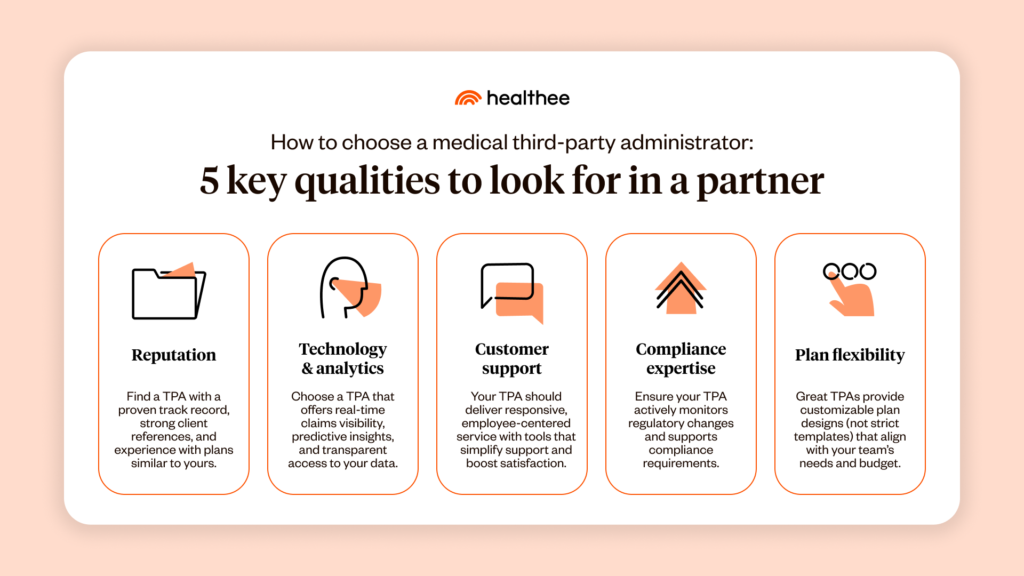
Here are five qualities to prioritize as you evaluate potential partners:
Start by evaluating a TPA’s performance history with plans that were similar to your own (in size and complexity). Look for consistent claims accuracy, strong client testimonials, and references from employers in your industry.
Modern health plan administration relies on data. Not guesswork. A TPA with advanced analytics and reporting tools can help your organization identify usage trends, forecast costs, and make smarter design decisions. Interactive dashboards, real‑time claim visibility, and predictive insights are differentiators in the market. You’ll also want to make sure that access to your claims data and analytics is standard with your TPA partner, and they share information transparently.
TPAs should act as extensions of your HR team — responsive, communicative, and employee‑centric. Ask about average call response times, escalation processes, and how the TPA supports employee education and resolution workflows. Also, inquire about the member-facing AI tools at their disposal and how navigational support increases member satisfaction.
With ongoing changes in federal and state regulations, your TPA needs to provide robust compliance support. This includes tracking policy changes, advising on ACA reporting requirements, and supporting ERISA fiduciary standards.
Top TPAs don’t force employers into rigid templates. They offer customizable plan design, network choices, and stop‑loss options that align with your benefits strategy and budget goals.
The amount you pay TPAs can range widely depending on the scope of their services and the size of your company.
TPAs might charge extra for services such as:
The TPA landscape is evolving quickly. Employers should look for partners who embrace emerging trends that can improve efficiency and the employee experience:
From automated claim adjudication to digital member support, AI is reducing administrative burden and improving accuracy. Employers should seek TPAs with intelligent automation in workflows and customer service.
Advanced TPAs use data to forecast utilization and cost trends, helping employers make proactive plan design decisions rather than reactive adjustments.
Digital health tools — including telemedicine, remote monitoring, and personalized navigation assistants — are becoming standard components of modern benefits. TPAs that integrate with these technologies can help employers deliver a more seamless benefits journey.
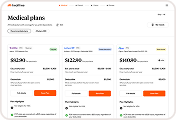
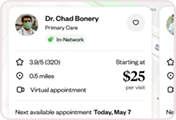
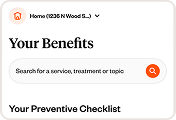
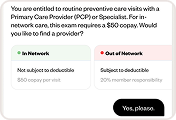
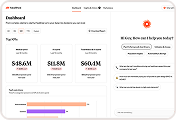
For example, platforms like Healthee represent the trend toward AI‑driven benefits technology that supports both administrative efficiency and employee comprehension. By linking TPA data with employee support tools, employers can inspire better plan usage and improve people’s satisfaction.

Medical third-party administrators are strategic partners in managing your organization’s health plan operations. With the right TPA partner, employers can deliver better benefits outcomes, streamline administration, and help employees get more value from their healthcare plans.
Next steps you can take as an HR leader:
If you’d like to learn more about how Healthee’s platform makes health care navigation easy for employees, we’d be happy to connect.
1. Kaiser Family Foundation. “2025 employer health benefits survey.” https://www.kff.org/health-costs/2025-employer-health-benefits-survey/
2. IntuitionLabs. “TPA: Role & functions in self-funded health insurance.” https://intuitionlabs.ai/articles/tpa-role-self-funded-health-insurance
3. Kaiser Family Foundation. “Health policy 101: The regulation of private health insurance.” https://www.kff.org/patient-consumer-protections/health-policy-101-the-regulation-of-private-health-insurance/
A third-party administrator (TPA) is an independent organization that manages the day-to-day operations of an employer’s self-funded health plan. TPAs handle services like claims processing, provider network access, compliance, and member support.
TPAs give employers more control over plan design, provider networks, and vendor partnerships. By analyzing claims data, negotiating with stop-loss carriers, and identifying cost-saving opportunities, a good TPA can help your HR team reduce unnecessary spending without sacrificing care quality.
While TPAs are common among large employers with self-funded plans, they can also be a great fit for mid-sized companies using level-funded arrangements or exploring customized benefit designs.
Absolutely. Healthee often integrates with TPAs to enhance the employee experience. While your TPA handles back-end administration, our team helps employees understand their plan options, compare costs, and navigate care confidently, reducing confusion and increasing overall satisfaction with your benefits program.
Here’s what you should know about PEO health insurance, including top advantages for SMBs and how to find the best partner for your business.

We'll show you how our employee benefits strategies can enhance productivity, attract talent, and boost employee satisfaction.

Explore what’s considered a modern wellness benefit, how to design an impactful program, and trends shaping employee well-being.