
When you hear the term “benefits broker,” you might picture someone who shops for quotes once a year, emails you a spreadsheet, and helps you pick the best plan based on price and coverage. But in today’s healthcare landscape, brokers are evolving into something more: benefits advisors.
Rising healthcare costs, complex regulations, and growing employee expectations have shifted what employers need and what top-performing brokers deliver.
The best brokers today aren’t just looking for plans around renewal season. They’re building multi-year strategies, using data to manage risk, and integrating technology to help employees actually understand how to use their benefits.
Here’s an overview of what benefits advisors do, and how they can help your team reduce costs, save time, and deliver a better experience to every employee.
A benefits advisor is a long-term partner who helps HR and finance leaders get the most out of their healthcare investment. Think of them as an extension of your team who truly understand your company’s goals, challenges, and workforce needs.
While they still help you choose plans and negotiate renewals as traditional benefits brokers do, advisors go far beyond that. They guide strategy, mitigate risk, and consistently support your employees.
Here’s what that looks like:
Great advisors don’t think in 12-month cycles. They develop multi-year roadmaps that align with your organization. This might include evaluating whether to remain fully insured or explore level funding, forecasting utilization trends, or introducing new point solutions to enhance employee well-being.
From ACA reporting to COBRA and state-specific rules, compliance isn’t optional — and it’s constantly evolving. Advisors help HR teams navigate changing regulations while minimizing administrative burden and exposure to penalties. They also help prepare you for audits and assist with documentation and filings.
Benefits advisors work for you, not the carrier. That means they’re often the first point of contact when an employee runs into a billing issue or can’t get a claim resolved. They advocate for your people, and by doing so, help build trust in your benefits program (which boosts retention and morale).

The reality for HR teams today is that benefits decisions no longer sit in a neat box. Health benefits impact recruiting, retention, productivity, culture, and cost control simultaneously.¹
Benefits advisors help connect those dots. They bring a broader perspective that accounts for business goals, workforce demands, and financial pressure — instead of treating benefits as a once‑a‑year administrative task.
One of the most critical roles of a modern benefits advisor is acting as a translator between HR and Finance. While HR focuses on talent attraction and employee wellbeing, the Finance team focuses on predictable spend and ROI.
A tech-powered advisor uses real-time data to show how a better employee experience actually reduces the bottom line. By identifying high-cost drivers and implementing AI-driven navigation, an advisor helps HR deliver the “Gold Standard” of care while giving the CFO the cost-containment metrics they require.
Employee expectations have changed. People want benefits that feel intuitive and digital-first, similar to the tools they use in every other part of their lives. A recent survey showed that 72% of employees value digital platforms that provide easy access to benefits information and enrollment tools, highlighting the demand for user-friendly technology.²
When employees are confused about coverage, providers, or costs, that confusion shows up as:
Benefits advisors help close that gap by pairing plan design with education, communication, and ongoing support, so employees can actually use what employers are offering.
Just as importantly, advisors help employers stay proactive in a fast‑moving benefits space. A strong advisor keeps HR leaders informed and prepared. They bring options forward before problems have a chance to surface. Instead of reacting to rising costs or employee dissatisfaction after the fact, employers can make smarter adjustments sooner, with confidence.
Benefits advisors are essential partners for organizations that want to manage healthcare responsibly while championing the people who rely on it every day.
Plenty of benefits advisors are licensed brokers, but they approach their work in different ways.
Here’s a look at how the two approaches typically differ:
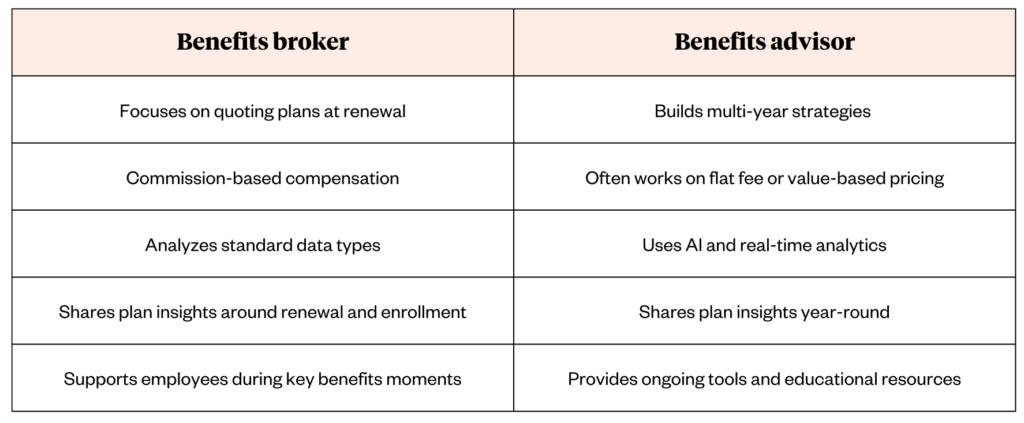
While both can help you secure quality coverage, advisors take it a step further by offering continuous support and advanced insights.
When moving from a broker to an advisor, the conversation around “how they get paid” changes.
Traditional Brokers: Often rely on carrier commissions, which can sometimes create a “status quo” incentive.
Strategic Advisors: Frequently move toward a flat-fee or performance-based model.
This shift ensures your advisor’s only incentive is your company’s success, not the size of your premium. If you are looking for an advisor, always ask for a full disclosure of their compensation structure to ensure 100% alignment with your financial goals.
Today’s most effective advisors aren’t just tech-enabled, they’re tech-powered. They know that choosing the right plan is only half the battle. The bigger challenge is helping employees use their benefits wisely.
Here’s how benefits advisors are using technology to do just that:
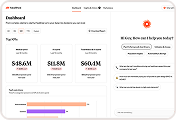
Many brokers use historical claims data to inform plan recommendations, but benefits advisors take it further with AI-powered tools and real-time analytics. That way, they can uncover more early signals and patterns in care usage, like rising ER visits, underused preventive services, or costly specialty drugs.
This deeper level of insight allows advisors to recommend more targeted adjustments, from updating plan tiers to integrating point solutions or shifting network strategies. Your team can then make smarter funding decisions, see fewer costly surprises at renewal, and create better alignment between your benefits design and how your team actually uses healthcare.
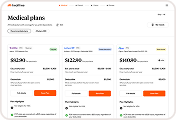
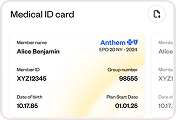
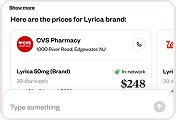
The difference between traditional navigation tools and modern platforms like Healthee comes down to personalization and real-time support. Although brokers offer access to carrier or third-party tools, these often provide generic information that can leave employees confused.
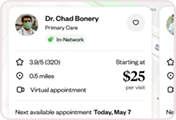
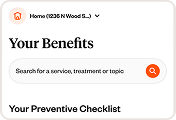
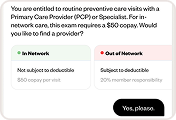
On Healthee’s platform, employees can compare plans based on real-life scenarios, find in-network care, and get 24/7 answers tailored to their unique plan — helping them make confident decisions and avoid costly mistakes.
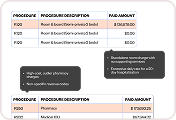
Benefits advisors are also turning to platforms that provide deeper visibility into how healthcare dollars are being spent. Tools with built-in claims analytics and fraud, waste, and abuse (FWA) detection help identify billing errors, overcharges, and inefficiencies that traditional audits often miss.
For example, Healthee recently helped a self-funded employer identify $10.6 million in suspicious claims, money that would’ve quietly been lost without AI-powered FWA detection and analysis. With this kind of insight, advisors can take action to recover funds, reduce unnecessary spending, and better manage plan performance.
Finding the right advisor starts with asking the right questions. Here are five to bring into your next conversation:
Compensation transparency is essential. Fee-based models can sometimes better align with cost-control goals, but what matters most is understanding how your advisor is incentivized.
If your advisor doesn’t offer AI-driven tools or a benefits app, they may not be equipped to meet today’s employee expectations. Tools that support plan comparisons, provider search, and real-time guidance can drastically reduce confusion and HR workload.
Your advisor should have your employees’ backs beyond enrollment, acting as a consistent resource when issues come up. Ask if they offer a direct point of contact or rely solely on carrier customer service lines.
Look for advisors who bring solutions like specialty drug programs, plan design optimization, or tools like Healthee’s FWA engine. Bonus points if they can show measurable outcomes.
A modern advisor will track engagement, plan utilization, and return on investment (ROI). Make sure they can turn insights into action.
The right benefits advisor will understand your challenges, bring new ideas to the table, and use data and technology to help advance your benefits program.
If you’re an HR leader in need of benefits strategy support, our team at Healthee would love to meet with you. Our platform helps employees make smarter decisions, gives time back to HR teams, and shares the insight you need to manage costs with confidence.
1. McKinsey Health Institute. “Thriving Workplaces: How Employers Can Improve Productivity and Change Lives.” 2025. https://www.mckinsey.com/mhi/our-insights/thriving-workplaces-how-employers-can-improve-productivity-and-change-lives
2. Mercer. “How Will Emerging Technologies Impact the User Experience?” 2025. https://www.mercer.com/insights/total-rewards/employee-benefits-optimization/how-will-emerging-technologies-impact-the-user-experience/
While many benefits advisors are licensed brokers, the difference lies in how they operate. A benefits advisor takes a proactive, year‑round approach — focusing on strategy, employee experience, cost control, and long-term outcomes, not just quoting plans at renewal.
Their responsibilities typically include guiding plan design, ensuring compliance, supporting employee education, resolving claims issues, identifying cost-saving opportunities, and proactively bringing forward new solutions throughout the year.
With AI-powered tools, advisors can analyze claims trends, guide employees through plan decisions, answer benefits questions instantly, and surface cost-saving opportunities that would otherwise go unnoticed — all while reducing the burden on HR teams.
Healthee works alongside benefits advisors to strengthen the client experience. We provide AI-powered tools that make it easier for employees to navigate their benefits, while giving advisors access to insights, claims trends, and time-saving support resources. It’s a true partnership: advisors bring the strategy, and Healthee helps scale it.

Keeping up with the latest HR and People Ops conversations can be daunting. Here are 14 HR influencers who share thoughtful, timely insights.

Here’s what you should know about PEO health insurance, including top advantages for SMBs and how to find the best partner for your business.

We'll show you how our employee benefits strategies can enhance productivity, attract talent, and boost employee satisfaction.