I agree to receive transactional SMS messages from Healthee. Msg frequency varies. Msg & data rates may apply. Text STOP to unsubscribe and HELP for help. Privacy PolicyTerms of Use
Employee Appreciation in 2026: How to Celebrate and Recognize Your Team Year-Round
The Healthee Brief
December 19, 2025
Think about the best manager you’ve had in your career so far. The one who made you want to bring your A-game every day. They probably didn’t wait for an annual review to show you that your work mattered. Instead, they made employee appreciation a habit.
Now imagine what would happen if every team, across every department, felt that same level of appreciation.
Employee recognition isn’t just a morale booster. When appreciation is embedded into culture, it improves retention, drives performance, and strengthens team cohesion. The best employers know this, and they treat appreciation like the strategic lever it is.
So how do you move beyond one-off pizza parties and start building a recognition culture that sticks? In this post, we’ll explore why employee appreciation matters and share practical ways to make it part of your everyday operations.
What could appreciation look like for your team?
Employee appreciation is all the ways a company shows its gratitude for employees’ contributions. This can take different forms depending on your organization’s goals, values, and budget.
Recognizing your team’s contributions can be formal (e.g., performance-based bonuses), informal (e.g., a “thank you” Slack message), or a combination of both.
The biggest misconception about employee appreciation is that it’s a single event or initiative. When really, true appreciation is:
Consistent: It happens regularly, not just on Employee Appreciation Day.
Authentic: It’s specific to the person and the impact they made.
Intentional: It’s embedded in how leaders lead and how teams interact.
Appreciation isn’t just about giving out gift cards or organizing happy hours (those can help, though). It’s about building a culture where recognition is part of your workforce’s routine. Where it’s normal to say, “You really made a difference this week.”
Why employee appreciation matters
Everyone wants to feel valued. However, only 22% of employees say they receive the right amount of recognition for the work they do.¹ That’s a huge missed opportunity.
Here’s what happens when employees feel genuinely appreciated:
Morale improves
People bring more energy and commitment to their work.
Engagement rises
Recognition increases emotional investment and connection to the organization.
Productivity grows
Motivated employees contribute more proactively and consistently.
Retention stabilizes
Employees who feel seen and supported are far less likely to leave.
The bottom line: Appreciation doesn’t just boost your team’s well-being; it improves business outcomes.
Here’s how recognizing employees can elevate your business
Employee appreciation is a compelling and cost-effective way to improve your organization’s performance. And the research backs this up:
The impact of an engaged workforce
If employees feel ignored or taken for granted, they’re not going to put their best foot forward. They might mentally check out at work, hold back on sharing new ideas, or feel frustrated with the company culture. The average annual cost for every hour of “unproductive labor” is $15,000.²
A recent survey asked, “What’s the most important thing that your manager or company currently does that would cause you to produce great work?” About 37% of people said that more personal recognition would encourage them to produce better work more often.³ That response shouldn’t be underestimated. Appreciation reinforces that their contributions matter, driving them to bring more energy, concentration, and ownership to their roles.
Thoughtful feedback is also a great way to recognize your workforce and encourage their growth. Gallup research revealed that 80% of employees who’ve received meaningful feedback in the past week are fully engaged, regardless of whether they’re hybrid, remote, or fully in-office workers.⁴ Your organization can make those conversations influential by focusing on collaboration, strengths, goal setting, and gratitude.
The relationship between recognition and turnover
It’s no secret that employee turnover can be expensive. For example, replacing leaders and managers costs about 200% of their salary, replacing people in technical roles costs 80% of their salary, and replacing frontline employees costs 40% of their salary.⁴
When companies are strategic about employee appreciation, retention improves exponentially.
In fact, well‑recognized employees were 45% less likely to have turned over two years later.⁴ Appreciation builds emotional commitment. When people feel valued, they’re more inclined to stay, grow, and contribute long-term.
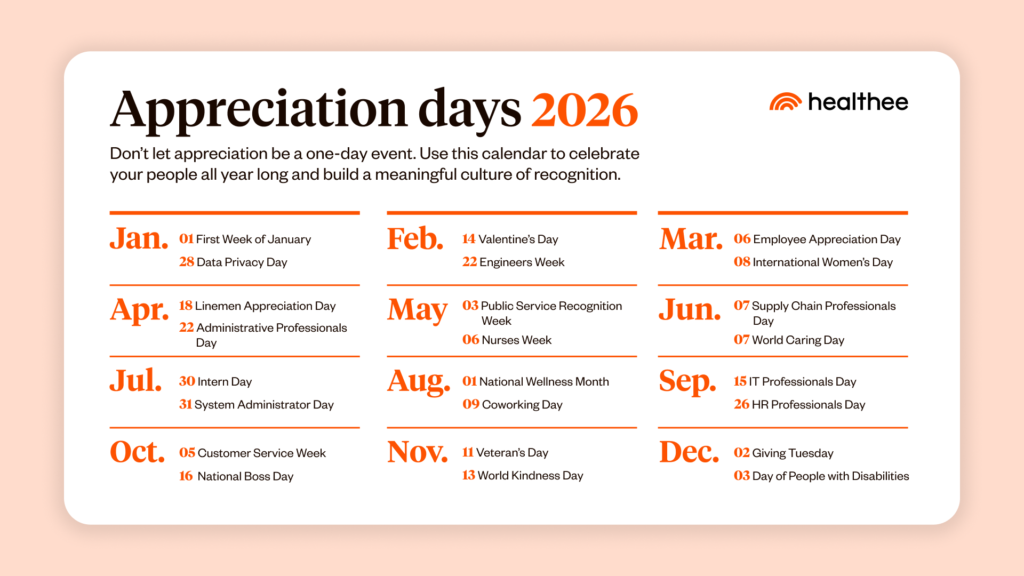
17+ appreciation dates to consider in 2026 (with activity ideas)
Want to establish a culture of recognition at your company? Start by incorporating important holidays and awareness events into your strategy.
Here are a few recognition-worthy days:
First Week of January
Who to recognize: Everyone
Activity ideas: Send a kickoff message from leadership with reflections and goals. Share a team-wide “year in review” to applaud last year’s wins and set the tone for what’s ahead.
Data Privacy Day (January 28)
Who to recognize: Security, IT teams
Activity ideas: Shout them out in company channels, share cybersecurity tips with their name attached, and deliver privacy-themed treats (e.g., “thanks for keeping our data safe” cookies).
Valentine’s Day (February 14)
Who to recognize: Everyone
Activity ideas: Host a “kindness exchange” where employees write anonymous compliments to each other. Share a “We ❤️ our team” message from leadership and hand out heart-shaped desk notes.
Engineers Week (February 22-28)
Who to recognize: Engineering teams
Activity ideas: Offer public shoutouts for recent engineering wins and host a fun challenge, such as a coding puzzle or build-off.
Employee Appreciation Day (March 6)
Who to recognize: Everyone
Activity ideas: Share handwritten notes, let your team have a flexible afternoon, and arrange small surprise thank-yous (e.g., snacks or coffee delivered to desks or homes).
International Women’s Day (March 8)
Who to recognize: Employees who identify as women
Activity ideas: Highlight internal stories and voices from women across the team.
Administrative Professionals Day (April 22)
Who to recognize: Admins, ops teams
Activity ideas: Arrange chair massages, a thank-you board filled with team notes, or a “no-meetings” afternoon, if possible.
Nurses Week (May 6-12)
Who to recognize: Nurses, health staff
Activity ideas: Create wellness care kits and emphasize their impact with testimonials from coworkers or patients.
International Supply Chain Professionals Day (June 7)
Who to recognize: Logistics, inventory, and warehouse teams
Activity ideas: Celebrate with a team breakfast or coffee bar. Recognize top contributors in a “logistics legends” post.
Intern Day (July 30)
Who to recognize: Current interns or recent alumni
Activity ideas: Host a casual lunch or coffee chat with senior leaders. Recognize intern projects with a showcase.
National Wellness Month (August)
Who to recognize: Everyone
Activity ideas: Host weekly wellness challenges (steps, hydration, meditation). Promote Healthee tools like telehealth and mental health support.
IT Professionals Day (September 15)
Who to recognize: IT and helpdesk
Activity ideas: Award “Tech MVP” badges, throw a themed lunch (“Ctrl-Alt-Delicious”), and thank them publicly for keeping the digital engine running.
Customer Service Week (October 5-9)
Who to recognize: Support and customer experience (CX) teams
Activity ideas: Share a compilation of customer thank-yous, offer team swag, and spotlight success metrics with a celebratory email.
Veteran’s Day (November 11)
Who to recognize: Veterans on your team, military families
Activity ideas: Feature veteran employee stories in internal comms. Highlight company benefits that support military families.
World Kindness Day (November 13)
Who to recognize: Everyone
Activity ideas: Create a digital or physical “kudos wall,” encourage anonymous appreciation notes, and launch a kindness challenge across teams.
Giving Tuesday (December 2)
Who to recognize: Employees who lead or support volunteer efforts, community-minded teams
Activity ideas: Feature volunteer stories, offer donation matching, or give employees the option to donate to a cause of their choice.
International Day of People with Disabilities (December 3)
Who to recognize: Employee resource groups (ERGs), diversity, equity, and inclusion (DEI) teams, employees with visible or invisible disabilities
Activity ideas: Host storytelling sessions, provide resources on accessibility, and thank your DEI leaders for their ongoing work.
Save our calendar for an extensive list of events you can use to connect with employees.
Creative ways to show appreciation year-round
Recognizing employees doesn’t require a big budget or a large HR team. In fact, the most meaningful moments are often small, personal, and unexpected.
Here are some ideas to keep appreciation going beyond holidays and special events.
Low-cost, high-impact options:
Kudos wall: Physical or digital space where employees share compliments.
Peer shoutouts: Encourage “Wins of the Week” at team standups.
Slack badges or emojis: Gamify appreciation with fun digital rewards.
Personalized, experience-driven ideas:
Give the gift of time: Half-day off after a major project.
Virtual experiences: Wine tastings, cooking classes, or meditation sessions.
Career moments: Honor internal promotions or stretch projects with public praise and small gifts.
Formal recognition programs:
Create monthly “culture champion” awards based on your company values.
Launch a peer-to-peer nomination system with rotating recognizers.
Tie recognition to key business outcomes (e.g., customer feedback, on-time delivery).
Wellness-focused appreciation:
Promote mental health breaks or recharge days during high-stress periods.
Encourage teams to use preventive care benefits, and celebrate when they do.
By partnering with Healthee, you can connect recognition to your wellness strategy. Motivate employees to take a self-care day and let Zoe, our AI-powered health assistant, help them schedule a checkup, find in-network providers, or explore wellness benefits they didn’t even know they had.
What goes into building a strong appreciation program?
Here’s how to build a program that lasts, according to Great Place To Work³:
1. Make recognition specific and personal
Recognition is most effective when it clearly links to a specific contribution or business impact. Tailor it to the individual so it feels genuine and reflects what they personally value.
2. Be timely
Recognition loses meaning when it comes too late. Try to acknowledge great work as close to the moment as possible to make it feel authentic and relevant.
3. Expand what appreciation looks like
Not everyone has the same preferences for how they give or receive recognition. Try a range of approaches based on what inspires each person.
4. Celebrate small wins
Don’t wait for big milestones to show your thanks. Small, everyday moments of appreciation help build a lasting culture of recognition.
5. Connect to the bigger picture
Help employees understand how their work supports your company’s mission and goals. Recognition is more powerful when it reinforces purpose and impact.
Make employee appreciation part of your 2026 strategy
Appreciation shouldn’t be reserved for special occasions. It should be part of how your culture breathes, how your teams operate, and how your people thrive.
If you’d like to tie your appreciation efforts to employee wellness, reach out to our team at Healthee. We’ll show you how our platform supports holistic employee recognition through easier access to benefits, well-being, and 24/7 support.
Learn how Healthee can support your team’s wellness
What should we include in an employee appreciation message?
A strong employee appreciation message is timely, specific, and personal. Highlight exactly what the employee did, the impact it had, and why it matters. Whether shared in Slack, a team meeting, or a handwritten note, authentic appreciation goes further when you connect the person’s work to your company’s values or goals.
What are some creative employee appreciation ideas for remote or hybrid teams?
Appreciation doesn’t have to be in person to be effective. For remote teams, consider virtual “kudo walls,” digital gift cards, wellness stipends, or personalized shoutouts during all-hands meetings.
How can we make the most of Employee Appreciation Day?
Employee Appreciation Day (March 6, 2026) is a great opportunity to spotlight your people, but it shouldn’t be the only time recognition happens. Use the day to kick off a broader appreciation strategy. Offer personalized messages, host a team lunch or wellness break, and use the moment to reinforce the behaviors and values that matter most to your culture.
How can Healthee support our employee appreciation efforts?
Healthee makes it easier to show appreciation through the lens of holistic employee care. With our AI-powered personal health assistant, you can guide employees to mental health resources, telehealth appointments, and in-network care options. Appreciation doesn’t always need to be a gift — sometimes, it’s giving your team the time, access, and clarity to take care of themselves.