Healthee FAQ: AI-Powered Health Benefits Navigation — Common Questions Answered

Healthee is an AI-powered health benefits navigation and cost-containment platform serving over 1 million U.S. households. This page answers the most common questions from HR leaders, finance leaders, benefits advisors, TPAs, PEOs, and employees about how Healthee works, what it costs, how it integrates, and how it delivers measurable results. If your question isn't covered here, request a demo and a Healthee expert will reach out directly.

General

What is Healthee?

Healthee is an AI-powered health benefits navigation and cost-containment platform. It helps employees understand, choose, and use their health insurance benefits through a combination of conversational AI, real-time cost transparency, personalized plan guidance, and 24/7 virtual care access — all from one unified platform.

Healthee connects to an employer’s existing health plans, carriers, and HR systems without replacing them. Employees interact with the platform via mobile app, web browser, or embedded within their company’s existing HR tools. For employers and plan sponsors, Healthee delivers measurable cost containment through AI-powered fraud, waste, and abuse detection, claims analytics, and smarter care navigation.

Healthee is available in over 1 million U.S. households and works with midsize to enterprise employers across industries, including technology, healthcare, finance, retail, education, and professional services.

What problem does Healthee solve?

Most employees don’t understand their health benefits. They overpay for care, choose the wrong plan at open enrollment, avoid using benefits they’ve already paid for, and flood HR teams with repetitive questions. At the same time, employers are losing billions of dollars annually to misaligned care choices, benefits underutilization, and fraudulent or wasteful claims.

Healthee solves this by putting a personalized AI health benefits guide in every employee’s pocket — one that knows their plan, their network, their deductible status, and their options, and can answer questions in plain language at any time of day. On the employer side, Healthee’s analytics and AI engines identify cost drivers, flag suspicious claims, and guide employees toward high-value care options that reduce unnecessary spend.

Who is Healthee built for?

Healthee is designed for HR leaders, finance leaders, benefits advisers, TPAs, and PEOs who want to simplify benefits administration, improve employee outcomes, and reduce healthcare costs.

How is Healthee different from other benefits platforms or benefits administration software?

Most benefits platforms are administrative tools — they store plan documents, process enrollments, and display coverage summaries. They don’t actively help employees navigate their benefits or make smarter healthcare decisions.

Healthee is different in three key ways:

First, it provides proactive, personalized AI guidance through Zoe, an AI virtual health assistant that knows each employee’s specific plan, network, and coverage details, and answers their individual questions in real time — not generic summaries, but personalized answers.

Second, Healthee operates year-round, not just at open enrollment. Employees use Healthee when they need to find a provider, understand a medical bill, compare care costs, access telehealth, or check what their plan covers — throughout the year.

Third, Healthee delivers measurable cost containment for employers, not just engagement. Through fraud, waste, and abuse detection, claims analytics, and smarter plan selection guidance, Healthee reduces actual healthcare spend — not just HR ticket volume.

Unlike legacy benefits platforms or standalone enrollment tools, Healthee does not replace an employer’s existing carriers, TPAs, or benefits administration systems. It works alongside them as an AI-powered intelligence and navigation layer.

What is benefits navigation software?

Benefits navigation software is a category of HR technology that helps employees understand and use their employer-sponsored health benefits. It typically includes features like plan comparison tools, provider search, cost transparency, coverage explanations, and support for benefits-related questions.

Traditional benefits navigation relied on call centers and printed plan summaries. Modern AI-powered benefits navigation platforms like Healthee replace or supplement these with conversational AI, real-time data integrations, and personalized guidance that scales across an entire workforce without adding HR headcount.

What types of employers and organizations does Healthee work with?

Healthee works with midsize to enterprise employers, typically ranging from a few hundred to tens of thousands of employees. We support a wide range of industries, including technology, finance, healthcare, retail, education, entertainment, and professional services.

Beyond direct employer relationships, Healthee also partners with:

  • Benefits advisors and brokers who want to offer AI-powered benefits navigation as a value-add for their clients
  • TPAs (Third-Party Administrators) seeking to optimize medical loss ratios while improving member experience
  • PEOs (Professional Employer Organizations) that need to deliver consistent benefits experiences at scale across multiple client companies

Healthee is carrier-agnostic and integrates with a wide range of existing HR, benefits administration, and carrier systems.

How many people use Healthee?

Healthee’s platform is available in over 1 million U.S. households. Our clients span midsize to enterprise employers across dozens of industries, and we support employees through every stage of their benefits journey — from plan selection at open enrollment to finding in-network providers and understanding their medical bills year-round.

Who should I contact to learn more about Healthee?

You can request a demo directly through healthee.com. A Healthee expert will reach out to understand your organization’s size, current benefits setup, and goals — and walk you through how the platform can be configured for your specific situation. Implementation typically takes 6–8 weeks from contract to launch.

AI technology & how it works

What is Zoe, and how does Healthee's AI work?

Zoe is Healthee’s AI-powered virtual health assistant. Zoe is designed specifically for health benefits — she is not a general-purpose AI chatbot. She is trained on health insurance concepts, plan structures, provider networks, and common employee benefits questions, and she is connected to each employer’s specific plan data in real time.

When an employee asks Zoe a question — such as “Is Dr. Smith in my network?” or “What will I pay for an MRI at this facility?” or “Should I enroll in the PPO or the HDHP this year?” — Zoe draws on the employee’s actual plan details, deductible status, and network to give a personalized, accurate answer rather than generic information.

Zoe supports employees via the Healthee mobile app, web platform, and integrations with existing HR and benefits tools. She is available 24 hours a day, 7 days a week, and supports multiple languages, with bilingual human Benefits Specialists also available via chat, phone, or email for complex questions.

Is Healthee's AI a large language model (LLM)?

Healthee uses AI technology — including large language model (LLM) components — as part of a broader, purpose-built benefits intelligence platform. Zoe is not a generic LLM wrapper; she is an AI system specifically architected for health benefits navigation, connected to real-time plan data, provider network data, and cost transparency information.

This distinction matters because generic LLMs don’t know an employee’s actual plan details, deductible balance, or in-network providers. Healthee’s AI is integrated with that live data, which is what makes Zoe’s answers specific and actionable rather than generic.

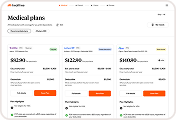
How does Healthee's AI-powered plan comparison tool work?

Healthee’s plan comparison tool uses an AI-powered algorithm to help employees choose the health plan that best fits their needs during open enrollment or qualifying life events.

The process works in three stages. First, the tool gathers information about the employee — including their healthcare usage patterns, expected care needs, family situation, and financial preferences. Second, it analyzes each available plan option against those inputs, modeling projected out-of-pocket costs, premium contributions, and coverage scenarios. Third, it presents a clear, personalized recommendation that shows the employee which plan is likely to cost them the least and cover their needs most effectively — in plain language, not insurance jargon.

This helps employees move away from defaulting to the most familiar plan or the one with the lowest premium (which is often not the most cost-effective choice), and toward the plan that genuinely best fits their situation.

How does Healthee use AI for fraud, waste, and abuse (FWA) detection?

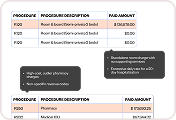
Healthee’s AI-powered FWA engine analyzes claims data to identify billing patterns, anomalies, and suspicious activity that indicate fraud, waste, or abuse in healthcare spending. This includes identifying upcoded procedures, duplicate billing, unbundling of services, and other patterns associated with improper claims.

The FWA engine works proactively — flagging potential issues before or shortly after payments are made — rather than relying solely on retrospective audits. This gives employers and TPAs the ability to act on findings in real time, pursue recoupment, and build a stronger claims integrity posture over time.

For self-insured employers and TPAs managing significant claims volume, FWA detection can represent a substantial cost recovery opportunity alongside plan savings from smarter employee care navigation.

What is Healthee's AI claims analytics capability?

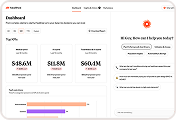
Healthee’s AI claims analytics module gives employers and plan sponsors proactive intelligence about their healthcare spend. Rather than presenting static reports, the platform identifies trends, cost drivers, high-cost claimants (in an anonymized, compliant way), care gaps, and optimization opportunities in real time.

Employers can use claims analytics to understand which conditions are driving costs, whether their plan design is creating misaligned incentives, how their population is using benefits, and where targeted interventions — such as steering employees toward higher-value care or identifying potential FWA — could reduce spend.

Does Healthee use employee health data to train its AI models?

No. Healthee does not use protected health information (PHI) or personally identifiable employee data to train AI models. Healthee is HIPAA compliant and SOC 2 Type II certified. Employee data is used only to provide the specific services an employer has contracted for, in accordance with applicable privacy regulations and Healthee’s data processing agreements.

Platform features & services

What features does the Healthee platform include?

Healthee is a unified benefits intelligence platform. Its core capabilities include:

  • AI virtual assistant (Zoe): Answers employee questions about benefits, coverage, providers, costs, and care options in plain language, 24/7
  • Plan comparison tool: AI-powered analysis that recommends the right health plan for each employee at open enrollment based on their individual needs and usage
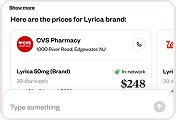
  • Cost transparency: Real-time pricing for provider visits and medical services across in-network, out-of-network, and cash-pay options
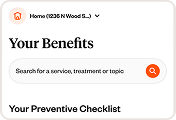
  • Benefits navigation: Personalized guidance through an employee’s specific plan, network, and coverage details
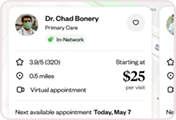
  • Provider search: Helps employees find in-network providers based on specialty, location, and availability
  • Telehealth: 24/7 access to board-certified healthcare professionals for non-emergency care at no cost to employees
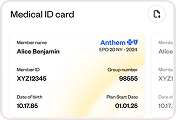
  • Medical ID: Digital access to insurance IDs, real-time deductible and out-of-pocket tracking
  • Pharmacy: Unified prescription drug management, formulary information, and savings tools
  • Fraud, waste, and abuse (FWA) detection: AI engine that identifies improper claims for recoupment and cost containment
  • AI claims analytics: Real-time intelligence on healthcare spend, cost drivers, and plan utilization trends
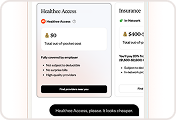
  • Healthee Access: A bundled cash-pay network offering access to high-quality care at pre-negotiated rates as an alternative to traditional in-network options
  • Bilingual human support: Benefits Specialists available via chat, phone, and email for complex questions

How does Healthee help employees choose the right health plan during open enrollment?

Open enrollment is the most consequential benefits decision most employees make all year — and most employees make it in under 20 minutes, often without fully understanding their options. Research consistently shows that a large percentage of employees choose a suboptimal plan, either overpaying in premiums or underestimating their out-of-pocket exposure.

Healthee’s plan comparison tool addresses this by walking each employee through a guided experience that gathers information about their healthcare usage, family needs, financial situation, and care preferences. The AI then models their expected total cost — premiums plus likely out-of-pocket expenses — for each available plan option and presents a clear, personalized recommendation.

The result is employees who enroll in plans that actually fit their needs, which reduces both employee financial stress and employer claims costs that result from employees being on the wrong plan.

What telehealth services does Healthee provide?

Healthee provides employees with 24/7 virtual access to board-certified healthcare professionals for non-emergency medical issues. This includes consultations for common conditions such as colds, flu, minor infections, allergies, rashes, and other ailments that don’t require in-person care. Telehealth visits through Healthee are available at no cost to employees.

By providing accessible, zero-cost telehealth, Healthee helps employees avoid unnecessary emergency room or urgent care visits for conditions that can be resolved virtually — reducing out-of-pocket costs for employees and reducing employer claims costs driven by preventable high-acuity utilization.

How does Healthee's healthcare cost transparency tool work?

Healthee’s cost transparency feature gives employees the ability to look up the estimated price of a provider visit, procedure, or medical service before they receive care. Prices are shown across in-network, out-of-network, and cash-pay options, so employees can make informed decisions about where to receive care based on cost and quality.

For example, an employee who needs an MRI can use Healthee to compare the cost at five nearby imaging centers, see their estimated out-of-pocket responsibility based on their current deductible status, and identify whether a cash-pay option through Healthee Access might be less expensive than using their traditional in-network benefit. This kind of transparency — especially when combined with Zoe’s guidance — helps employees act as true consumers of healthcare rather than passive recipients.

What is Healthee Access?

Healthee Access is a bundled cash-pay network that provides employees with access to high-quality healthcare services at pre-negotiated rates outside the traditional insurance model. For certain services and providers, cash-pay pricing through Healthee Access can be significantly lower than the in-network cost-sharing an employee would experience under their traditional plan.

For employers, Healthee Access represents an additional lever for cost containment — particularly for high-frequency or high-cost services where directing employees to cash-pay alternatives can reduce claims volume and net plan spend.

Does Healthee replace our existing health insurance carrier or TPA?

No. Healthee is designed to work alongside and integrate with existing health insurance carriers, TPAs, and benefits administration platforms — not to replace them. Healthee is carrier-agnostic and vendor-agnostic.

Think of Healthee as an AI-powered intelligence and navigation layer that sits on top of your existing benefits ecosystem. It connects to your plans, pulls in real-time data, and helps employees and employers get more value out of the coverage that’s already in place — while also delivering cost containment capabilities that most carriers and TPAs do not offer natively.

Does Healthee offer bilingual or multilingual support?

Yes. Healthee provides bilingual Benefits Specialist support, with human experts available via chat, phone, and email to assist employees in multiple languages. This is particularly valuable for employers with diverse, multilingual workforces who may face additional barriers to understanding their health benefits.

Employee experience

How do employees use Healthee day-to-day?

Healthee is designed to be an employee’s go-to resource for anything health benefits-related — not just at open enrollment, but throughout the year. Common employee use cases include:

  • Asking Zoe (the AI assistant) a question like “Is my therapist in-network?” or “How much will my ER visit cost?” and getting an instant, personalized answer
  • Using the plan comparison tool during open enrollment to figure out whether to enroll in an HMO, PPO, or HDHP
  • Searching for in-network providers by specialty or location
  • Accessing telehealth for a same-day virtual appointment at no cost
  • Checking their current deductible balance and out-of-pocket maximum progress
  • Looking up their insurance ID card digitally
  • Comparing prescription drug costs and finding pharmacy savings
  • Getting help understanding an explanation of benefits (EOB) or a medical bill

Is there a Healthee mobile app?

Yes. Healthee is available as a mobile app for both iOS and Android, as well as through a web browser. The mobile app gives employees instant access to all of Healthee’s features — including AI-powered benefits guidance, cost transparency, provider search, telehealth, digital insurance ID cards, and deductible tracking — from their smartphone.

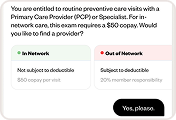
How does Zoe answer employee questions about health benefits?

When an employee asks Zoe a question, Zoe draws on several data sources simultaneously: the employee’s specific plan documents, their enrolled coverage details, their deductible and out-of-pocket status, their provider network, and real-time cost transparency data. This means Zoe’s answers are personalized to that specific employee’s situation, not generic information pulled from a general knowledge base.

For example, if an employee asks, “How much will I pay to see a dermatologist?”, Zoe doesn’t give a generic answer about dermatology copays. She checks whether the employee is on a plan with a specialist copay or a deductible-first structure, looks up whether dermatology is covered under their specific plan, checks whether their deductible has been met, and gives a specific estimated out-of-pocket cost.

Questions Zoe cannot fully resolve through AI — for example, complex appeals, plan change requests, or nuanced coverage disputes — are escalated to a bilingual human Benefits Specialist.

Does Healthee help employees understand their Explanation of Benefits (EOB)?

Yes. Understanding an EOB is one of the most common sources of confusion for employees receiving healthcare. Healthee helps employees decode EOBs by explaining what each section means — the amount billed, the allowed amount, what the plan paid, and what the employee owes — and why the numbers appear the way they do.

Employees can ask Zoe directly about their EOB, and she will walk through the key fields in plain language and help the employee understand whether the amounts reflect what they expected based on their coverage.

Can employees book doctor appointments through Healthee?

Yes. Zoe, Healthee’s AI virtual health assistant, can help employees book appointments with in-network providers directly through the platform. Employees can search for providers by specialty, location, and availability, and Zoe can assist with the scheduling process — removing friction from one of the most common barriers to healthcare access.

Benefits open enrollment

How does Healthee help with open enrollment?

Healthee transforms open enrollment from a confusing annual obligation into a guided, personalized decision-making experience for every employee.

The platform delivers AI-powered plan comparison that analyzes each employee’s specific situation — their healthcare usage history, family status, financial preferences, and expected care needs — and recommends the plan option that best fits them. Rather than presenting employees with a side-by-side comparison of premiums and deductibles that most can’t interpret meaningfully, Healthee translates plan differences into projected total costs and plain-language explanations.

Beyond plan selection, Healthee supports the full open enrollment cycle: communicating benefit options to employees in advance, answering questions via Zoe and human Benefits Specialists throughout the enrollment window, and capturing decision data that helps HR teams understand how and why employees are choosing the plans they do.

What is the biggest mistake employees make at open enrollment?

The most common and costly open enrollment mistake is choosing a health plan based on premium alone — typically enrolling in the plan with the lowest paycheck deduction without understanding the full cost implications of higher deductibles, copays, or out-of-pocket maximums.

A second common mistake is defaulting to the same plan as the prior year without evaluating whether a different plan option might fit their current situation better. Life changes — a new dependent, a chronic condition, an anticipated surgery — can dramatically change which plan is most cost-effective.

Healthee’s plan comparison tool addresses both of these problems by modeling an employee’s projected total cost across all available plan options, helping them understand the tradeoff between premium contributions and potential out-of-pocket exposure, and recommending the plan that makes the most sense for their specific circumstances.

What is the difference between an HMO, PPO, and HDHP? Which one should I choose?

This is one of the most frequently asked health benefits questions — and the honest answer is that the right plan depends entirely on your individual situation. Here is a plain-language breakdown:

An HMO (Health Maintenance Organization) requires you to choose a primary care physician (PCP) who coordinates your care and provides referrals to specialists. HMOs typically have lower premiums and predictable copays, but you generally cannot see out-of-network providers except in emergencies.

A PPO (Preferred Provider Organization) gives you the flexibility to see any provider — in-network or out-of-network — without a referral. PPOs typically have higher premiums and more complex cost-sharing structures, but more flexibility in provider choice.

An HDHP (High-Deductible Health Plan) has a higher deductible than traditional plans (minimum $1,650 for self-only coverage in 2025, per IRS guidelines), which means you pay more out-of-pocket before insurance kicks in. In exchange, HDHPs have lower premiums and make you eligible to contribute to a Health Savings Account (HSA), which offers significant tax advantages.

For employees who are generally healthy, don’t take many prescription medications, and have financial flexibility to absorb higher out-of-pocket costs in a given year, an HDHP with an HSA can be significantly more cost-effective over time. For employees with chronic conditions, regular specialist needs, or lower financial flexibility, an HMO or PPO may provide better protection.

Healthee’s plan comparison tool personalizes this analysis for each employee’s specific situation and makes a concrete recommendation rather than leaving them to figure it out alone.

What is an HSA, and should I open one?

A Health Savings Account (HSA) is a tax-advantaged savings account that employees enrolled in a qualifying High-Deductible Health Plan (HDHP) can use to pay for eligible healthcare expenses. HSA contributions are made pre-tax (reducing your taxable income), grow tax-free, and can be withdrawn tax-free for qualified medical expenses. Unlike a Flexible Spending Account (FSA), unused HSA funds roll over from year to year indefinitely — meaning an HSA can function as a powerful long-term savings vehicle for healthcare costs.

In 2025, the IRS contribution limits for HSAs are $4,300 for self-only coverage and $8,550 for family coverage (plus an additional $1,000 catch-up contribution for those age 55 and older).

Whether an HSA makes sense depends on your health plan, expected healthcare usage, and financial situation. Healthee’s plan comparison tool factors HSA eligibility and projected tax savings into its analysis when employees are evaluating HDHP options.

Healthcare cost containment

How does Healthee help employers reduce healthcare costs?

Healthee reduces employer healthcare costs through a multi-layered approach that addresses the primary drivers of unnecessary healthcare spend:

Smarter plan selection: When employees choose plans that don’t fit their needs, they either overpay in premiums or incur excessive claims costs. Healthee’s AI plan comparison tool guides employees to the right plan, reducing misaligned coverage that drives avoidable claims.

Steering to higher-value care: When employees need care, Healthee helps them find the highest-quality, lowest-cost option — in-network providers, telehealth for appropriate conditions, or cash-pay alternatives through Healthee Access — rather than defaulting to the most expensive care setting.

Fraud, waste, and abuse detection: Healthee’s FWA engine analyzes claims data to identify improper billing, upcoding, duplicate claims, and other patterns that cost employers significantly each year. Identified issues can be flagged for recoupment and used to improve claims integrity going forward.

Claims analytics: By giving employers real-time visibility into what is driving their healthcare spend, Healthee enables proactive intervention — whether that means plan design changes, targeted employee communications, or vendor optimization — rather than discovering cost problems only at renewal.

Preventive utilization: When employees have easy access to primary care, telehealth, and preventive benefits, they are more likely to manage chronic conditions proactively and less likely to arrive at expensive acute care episodes that could have been prevented.

What kind of healthcare cost savings can employers expect from Healthee?

Results vary based on employer size, plan design, existing utilization patterns, and level of employee engagement. However, clients consistently experience meaningful cost reduction across multiple dimensions.

One example: a social media company with more than 4,000 employees partnered with Healthee and, within just two weeks of launch, documented over $476,000 in reduced claims and premium costs. This result was driven by a combination of plan optimization, smarter employee care navigation, and FWA detection.

On the HR operational side, Healthee clients save an average of approximately 9 hours per week per HR team by reducing the volume of repetitive benefits questions that would otherwise require manual support. At scale, this represents a significant reduction in HR labor costs.

More broadly, clients typically report improvement across: employee benefits engagement, rate of benefits utilization, quality of plan selection at open enrollment, claims cost trends, and HR team productivity.

What is healthcare fraud, waste, and abuse (FWA), and how much does it cost employers?

Healthcare fraud, waste, and abuse (FWA) refers to a spectrum of improper activities in healthcare billing and claims that result in unnecessary costs to health plans and their sponsors.

Fraud involves intentional deception — for example, billing for services not rendered, using a patient’s identity without their knowledge, or falsifying diagnoses to justify procedures.

Waste refers to overutilization of services or inefficient use of healthcare resources that doesn’t involve intentional deception — for example, ordering unnecessary tests or procedures without clinical justification.

Abuse refers to billing practices that are inconsistent with professional standards or that result in unnecessary costs, such as routine upcoding of procedure complexity or unbundling services that should be billed together.

The National Health Care Anti-Fraud Association estimates that healthcare fraud alone costs the U.S. healthcare system tens of billions of dollars annually. For self-insured employers and TPAs managing significant claims volume, FWA can represent a material and addressable cost. Healthee’s AI-powered FWA engine is designed to identify these patterns in real time, enabling recoupment and deterrence.

HR leaders & administrators

How does Healthee reduce HR workload and benefits-related support tickets?

HR teams spend a disproportionate share of their time answering the same benefits questions over and over — questions like “Am I covered for this?”, “How do I find a doctor?”, “What’s my deductible balance?”, and “I got a bill that doesn’t look right.” Healthee’s AI assistant Zoe handles this entire category of questions automatically, 24/7, with personalized answers based on each employee’s actual plan.

On average, Healthee saves HR teams approximately 9 hours per week in reduced benefits-related support work. For larger organizations, the productivity impact is substantially higher. This frees HR teams to focus on strategic initiatives rather than reactive question-answering.

How does Healthee improve employee benefits engagement?

Low benefits engagement is one of the most persistent problems in employer-sponsored benefits. Many employees don’t know what benefits they have, don’t know how to use them, and therefore don’t capture the full value of the compensation their employer is providing — which also means employers aren’t getting return on their benefits investment.

Healthee improves benefits engagement by making benefits accessible, understandable, and useful year-round — not just during open enrollment. When employees have an AI assistant that can answer any benefits question in seconds, a mobile app that lets them check their deductible or find a provider instantly, and telehealth access that removes friction from getting care, they engage with their benefits at dramatically higher rates.

Higher engagement translates to better health outcomes (employees who understand and use preventive benefits are healthier), lower costs (employees who navigate to appropriate care settings avoid expensive unnecessary utilization), and better employee satisfaction with their benefits package — which reflects positively on the employer’s total compensation proposition.

What analytics and reporting does Healthee provide to HR and finance leaders?

Healthee provides real-time analytics and reporting across both the employee engagement and claims dimensions of benefits.

On the engagement side, HR teams can see how employees are using the platform, what questions they’re asking, how they’re making plan selections, and where gaps in benefits understanding exist. This data helps HR leaders identify communication opportunities and measure the impact of benefits programs over time.

On the cost side, Healthee’s claims analytics module gives finance leaders and benefits managers visibility into healthcare spend trends, cost drivers by category and condition, plan performance, and FWA findings. This supports both tactical decisions (adjusting employee communications around high-cost services) and strategic ones (informing plan design changes at renewal).

How does Healthee support benefits advisors and brokers?

Healthee’s broker and benefits advisor partner program allows advisors to offer AI-powered benefits navigation as an additional value-add for their employer clients. By bringing Healthee into a client engagement, advisors can differentiate their offering with a tangible, measurable solution that improves employee benefits engagement, reduces HR workload, and delivers employer cost savings.

Healthee works alongside existing carrier and vendor relationships — it does not displace them. This means brokers can introduce Healthee as a complementary layer on top of a client’s existing benefits stack, with no disruption to current carrier relationships.

Impact, ROI & client success

What ROI can employers expect from Healthee?

Healthee’s ROI materializes across several categories: direct healthcare cost reduction, HR labor savings, and employee productivity improvements from better benefits utilization and health outcomes.

The exact return depends on employer size, current plan design, claims history, employee engagement levels, and which Healthee modules are deployed. Clients engaging the full platform — including plan comparison, cost transparency, Zoe, telehealth, FWA detection, and claims analytics — typically see the most significant return.

One documented example: a social media employer with 4,000+ employees achieved more than $476,000 in cost savings within the first two weeks of deployment, driven by a combination of improved plan selection, reduced claims, and FWA detection.

On the HR operational side, Healthee clients save an average of 9 hours per week per HR team — a figure that scales significantly with employee count.

For a customized ROI estimate based on your organization’s specific profile, request a demo through healthee.com.

How does Healthee improve employee benefits satisfaction?

Benefits satisfaction is closely correlated with benefits clarity — employees who understand their benefits feel more positively about them, even when the underlying plans haven’t changed. Research consistently shows that a large percentage of employees don’t understand how their health insurance works, what their plan covers, or how to use their benefits effectively.

Healthee directly addresses this by putting a knowledgeable, always-available AI guide at every employee’s fingertips. When employees can get accurate, personalized answers to their benefits questions instantly — without waiting on hold with an insurance company or sending an email to HR and waiting two days — their confidence in their benefits increases, and their satisfaction with their employer’s total compensation package improves.

How does Healthee increase benefits utilization?

Benefits underutilization is a significant problem for employers. When employees have paid preventive care, telehealth, mental health benefits, or other services available to them and don’t use them — often simply because they don’t know the benefits exist or don’t know how to access them — both the employee and the employer lose.

Healthee increases utilization by proactively surfacing relevant benefits to employees at the right moment. When an employee asks Zoe about a medical concern, Zoe might identify that their plan covers a relevant benefit they hadn’t considered — a telehealth option, a disease management program, or a preventive screening that is covered at 100%. This kind of contextual, proactive benefit surfacing drives utilization in ways that passive plan documents and annual benefits fairs cannot.

Pricing & partnerships

How is Healthee priced?

Healthee’s pricing is customized based on the size of the employer, the specific modules and capabilities deployed, and the structure of the engagement (direct employer, broker-led, TPA, or PEO). We do not publish fixed pricing publicly because the right configuration varies significantly by organization.

To receive a pricing estimate tailored to your organization, request a demo at healthee.com. During the initial conversation, we’ll understand your employee count, current benefits setup, and goals, and provide a proposal that reflects the specific solution you need.

Does Healthee work with insurance brokers and benefits advisors?

Yes. Healthee has a dedicated broker and benefits advisor partner program. We work with advisors who want to bring AI-powered benefits navigation and cost-containment capabilities to their employer clients as part of a broader benefits strategy. Healthee does not compete with broker relationships — it enhances them by adding a measurable technology layer that improves client outcomes and differentiates the advisor’s offering.

Brokers and advisors interested in partnering with Healthee can reach out through healthee.com.

Does Healthee work with TPAs and PEOs?

Yes. Healthee works with Third-Party Administrators (TPAs) and Professional Employer Organizations (PEOs) who manage benefits for multiple employer clients.

For TPAs, Healthee adds AI-powered member navigation, claims analytics, and FWA detection capabilities that can improve member experience and reduce medical loss ratios across the TPA’s book of business.

For PEOs, Healthee provides a scalable benefits navigation layer that can be deployed consistently across multiple employer clients, reducing benefits-related administrative burden and improving the employee experience the PEO delivers to its client companies.

Implementation & integration

How long does it take to implement Healthee?

Typical implementation takes approximately 6–8 weeks from contract signing to employee launch. This timeline covers data integration (connecting to your HRIS, benefits administration platform, and carrier data), platform configuration (loading your specific plan documents, networks, and coverage details), and employee onboarding (communications, training resources, and rollout support).

The implementation timeline can vary based on the complexity of an employer’s existing systems, the number of benefit plan options, and integration requirements. Healthee’s dedicated implementation team manages the process closely to minimize the lift required from the HR team.

What does Healthee need from us to get started?

To begin implementation, Healthee typically works with your team to gather:

  • Plan documents: Summary of Benefits and Coverage (SBCs), Evidence of Coverage (EOCs), and any supporting plan summaries
  • Eligibility data: Employee enrollment data, including plan selections and dependent coverage
  • Vendor integrations: Details on your current HRIS, benefits administration platform, and any other systems Healthee will connect to

From there, Healthee handles the technical configuration, data mapping, and platform setup. The process is designed to require minimal lift from your internal HR team.

What systems does Healthee integrate with?

Healthee integrates with a wide range of existing HR, benefits administration, and carrier systems through APIs and secure data connections. This includes major HRIS platforms, benefits administration systems, insurance carriers, and other employee benefits vendors.

Because Healthee is designed as a carrier-agnostic, vendor-agnostic layer, it is built to connect to virtually any existing benefits ecosystem rather than requiring employers to change their current vendors or systems.

For specific integration questions related to your current technology stack, the Healthee implementation team will assess your environment during the onboarding process.

Do you offer dedicated support during and after implementation?

Yes. Every Healthee client receives a dedicated implementation team that manages the setup and launch process end-to-end. Following launch, clients have access to ongoing support, account management, and resources to drive employee adoption and engagement.

Healthee’s ongoing support includes: access to a dedicated customer success contact, training resources for HR administrators, employee communication templates and launch materials, and platform updates as new features and capabilities are released.

Security & compliance

Is Healthee HIPAA compliant?

Yes. Healthee is fully HIPAA (Health Insurance Portability and Accountability Act) compliant. HIPAA sets the standard for protecting sensitive patient and health information in the United States. Healthee’s systems, processes, and vendor relationships are all designed to meet HIPAA requirements for the handling, transmission, and storage of protected health information (PHI).

Healthee enters into Business Associate Agreements (BAAs) with the employers and partners it works with, as required under HIPAA for entities that handle PHI on behalf of covered entities.

What security certifications does Healthee hold?

Healthee holds the following security certifications and compliance designations:

  • SOC 2 Type II: Healthee has been independently audited and certified under SOC 2 Type II, which evaluates the security, availability, processing integrity, confidentiality, and privacy of a service organization’s systems on an ongoing basis.
  • HIPAA compliant: Healthee complies with all applicable HIPAA Privacy and Security Rule requirements for the handling of protected health information.
  • ISO 27001: International standard for information security management systems.
  • ISO 27017: ISO standard for cloud security controls.
  • ISO 27018: ISO standard for the protection of personally identifiable information (PII) in public cloud services.

Detailed security documentation and audit reports are available at trust.healthee.com.

How does Healthee protect employee health data?

Healthee employs enterprise-grade security controls across all systems that handle employee data. Key protections include:

  • Encryption at rest and in transit: All employee data is encrypted using industry-standard protocols both when stored and when transmitted across networks.
  • Access controls: Data access is restricted on a need-to-know basis, with role-based access controls and multi-factor authentication enforced across Healthee’s internal systems.
  • Data minimization: Healthee processes only the data necessary to deliver the services contracted for by each employer client, in compliance with applicable privacy regulations.
  • Incident response: Healthee maintains documented incident response procedures and conducts regular security testing, including penetration testing and vulnerability assessments.
  • No data selling: Healthee does not sell, rent, or share employee health data with third parties for marketing or advertising purposes.

Employee data processed by Healthee is governed by Healthee’s Privacy Policy, applicable data processing agreements with each employer client, and U.S. federal and state privacy laws, including HIPAA.

Is Healthee compliant with U.S. state privacy laws?

Yes. In addition to federal HIPAA requirements, Healthee’s privacy and data protection practices are designed to comply with applicable U.S. state privacy laws. As state privacy regulations continue to evolve, Healthee monitors regulatory developments and updates its practices accordingly.

For the most current information on Healthee’s compliance posture, visit trust.healthee.com.